
Age changes both what you report to your doctor and how your doctor interprets what you say. Older adults tend to describe symptoms in physical, functional terms — poor appetite, fatigue, a gradual loss of interest in daily activities — while younger adults are more likely to name emotional experiences like sadness, anxiety, or feeling worthless. That gap in language creates real diagnostic risk. A 70-year-old with depression may never say "I feel hopeless"; they say "I just don't feel like eating anymore." Research on age differences in symptom endorsement confirms this pattern in major depression, and the Agency for Healthcare Research and Quality (AHRQ) identifies age as a predictor of missed diagnoses across conditions.
Act now:
- Write down your symptoms in plain language, including when they started and how they differ from your normal baseline.
- Seek emergency care immediately for chest pain, sudden confusion, difficulty breathing, or new weakness on one side of the body.
- Bring a current medication list and, if possible, a caregiver who can describe changes in your daily function.
Table of Contents
- How do symptoms present differently across age groups?
- Why does age change how symptoms get interpreted?
- When should you seek care, and how urgently?
- How to describe symptoms so clinicians take them seriously
- What clinicians can do to reduce missed diagnoses
- Do digital symptom tools actually help across age groups?
- Key Takeaways
- Age, symptoms, and the gap between worry and action
- Useful sources and further reading
How do symptoms present differently across age groups?
The short answer: the same underlying condition can look completely different depending on the patient's age, and that difference is not subtle.

Older oncology patients in a cross-sectional study of outpatients reported significantly lower occurrence rates for many measured symptoms compared with younger patients, even after adjusting for covariates. Lower reported severity does not mean less disease. It often means the symptom is being filtered through a different interpretive lens.
Depression is the clearest example. Older adults with major depression are less likely to endorse emotional symptoms such as crying or feeling worthless, and more likely to describe poor appetite, low energy, or a drop in sexual interest. A 68-year-old man might tell his primary care doctor, "I just don't have any get-up-and-go lately," while a 34-year-old with the same diagnosis says, "I've been crying every day and I can't see the point of anything."
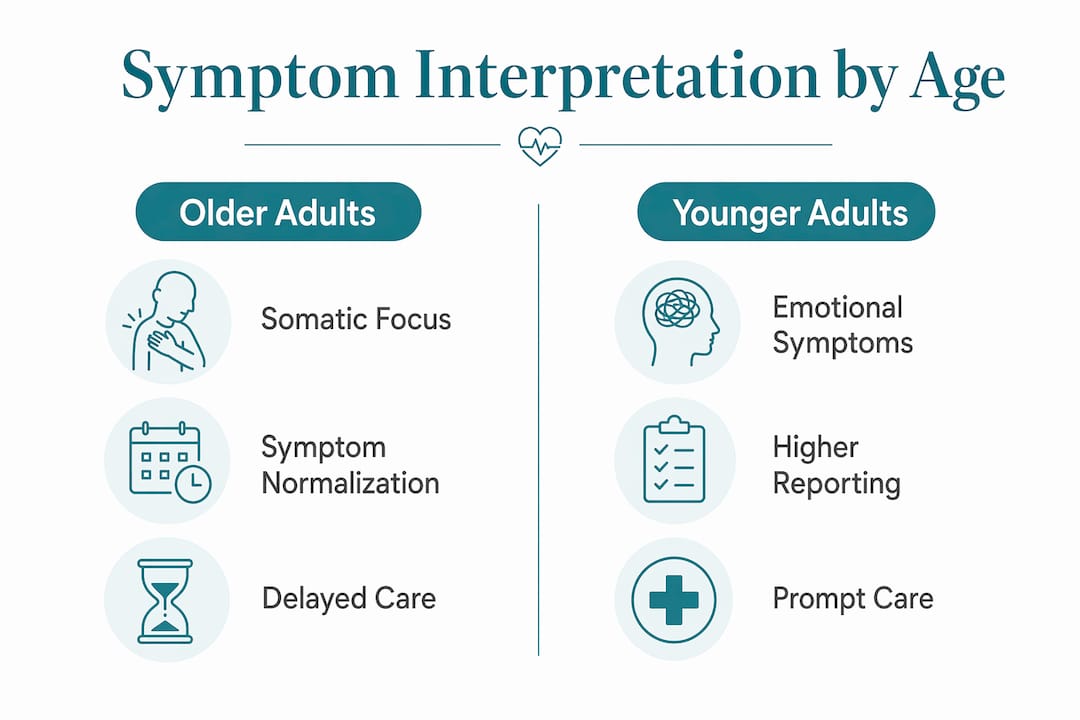
Cancer symptoms follow a related pattern. Increasing age is linked to prolonged appraisal intervals — the time between noticing a change and deciding it warrants medical attention. Older adults often recognize a symptom as serious once they do engage, but the delay in reaching that recognition can cost weeks or months.
Common age-linked symptom patterns:
- Older adults (60+): functional decline, appetite loss, sleep disruption, falls, confusion, reduced interest in usual activities, vague fatigue
- Middle-aged adults (40–60): musculoskeletal pain, fatigue, mood changes, cardiovascular symptoms
- Younger adults (under 40): emotional and affective symptoms, headache, gastrointestinal complaints, anxiety-linked physical symptoms
Population data shows that symptoms related to stress and strain tend to decrease with age, while sensory and musculoskeletal symptoms increase — a pattern that cuts across both sexes.
Why does age change how symptoms get interpreted?
The patient side: normalization and delay
The most consequential patient-side factor is normalization. Older adults frequently attribute new symptoms to aging itself rather than to a treatable condition. Research applying the Common Sense Model found that pain is typically labeled disease-related while memory loss is often labeled age-related — and that distinction directly predicts whether someone seeks help. Memory loss gets dismissed; pain gets acted on.
Beyond normalization, social and psychological barriers compound the delay: a desire not to "waste the doctor's time," fear of what a diagnosis might mean, fatalism, and social isolation all slow help-seeking. Companion support can meaningfully shift this dynamic — research on how companionship affects appetite and wellbeing in older adults suggests that social connection changes both symptom experience and the motivation to act on it.
The clinician side: cognitive bias and diagnostic heuristics
Clinicians are not immune to age-based assumptions. Quantitative analysis of diagnostic decision-making shows that clinician confidence and suspicion patterns shift with patient age, driven by unconscious cognitive biases — availability bias (assuming a common age-related cause), anchoring (locking onto the first plausible diagnosis), and representativeness (matching the patient to a mental prototype). A 75-year-old presenting with confusion is more likely to have delirium attributed to "just getting older" than to an underlying infection or medication interaction.
> AHRQ diagnostic-safety guidance is direct on this point: older adults are a heterogeneous group, and assuming symptoms are due to aging rather than conducting a comprehensive, individualized assessment is a recognized driver of missed and delayed diagnoses. Physiologic age, comorbidity burden, and communication barriers — hearing loss, cognitive slowing, limited health literacy — must all be factored into the clinical picture, not used as reasons to stop investigating.
Polypharmacy adds another layer. Older adults taking multiple medications may have symptoms caused or masked by drug interactions, and those symptoms rarely match textbook presentations.
When should you seek care, and how urgently?
Age-specific thresholds matter here. Older adults often need faster investigation for symptoms that might be monitored in a younger person, because physiologic reserves are smaller and conditions escalate more quickly.
| Symptom or red flag | Recommended action | Timeframe |
|---|---|---|
| Chest pain, pressure, or tightness | Seek emergency care immediately | Immediately |
| New confusion or delirium (especially in older adults) | Emergency evaluation | Immediately |
| Sudden weakness, speech difficulty, vision loss | Call 911 — possible stroke | Immediately |
| Unexplained weight loss over weeks | Primary care visit | Within two weeks |
| New memory changes or functional decline | Primary care, request cognitive screen | Within a few weeks |
| Persistent fatigue, appetite loss, mood change | Primary care | Within 2 weeks |
| Falls (single unexplained fall in older adult) | Primary care | Within one week |
| Gradual breathlessness on exertion | Primary care | Within two weeks |
New confusion or delirium in an older adult is a medical emergency until proven otherwise. AHRQ guidance specifically flags that decreased sensation, cognitive changes, and polypharmacy can mask acute conditions like infection, making rapid evaluation critical.
Pro Tip: Bring a written list of every medication you take, including over-the-counter drugs and supplements, plus any recent changes in dose. Note one or two specific things you can no longer do that you could do three months ago — that functional baseline is often more diagnostic than the symptom itself.
How to describe symptoms so clinicians take them seriously
Scripts matter. Vague complaints get vague responses. Here are opening lines that work:
- Cognitive changes: "I've noticed I'm forgetting things I used to remember easily — appointments, names, where I put things. This started about two months ago and it's getting worse, not better."
- Mood or motivation: "I've lost interest in things I used to enjoy. I'm not sad exactly, but I feel flat. My appetite has dropped and I'm sleeping more."
- Functional decline: "Three months ago I could walk to the mailbox without stopping. Now I can't. Something has changed."
- New pain or breathlessness: "This is new for me. It started [date], it happens when I [activity], and it's different from anything I've felt before."
The phrase "this is new for me" and "this is different from my normal" are the two most useful things you can say. They shift the frame from "aging complaint" to "change that needs explanation."
Printable checklist — bring this to every visit:
- Exact date symptoms started
- Whether symptoms are constant, intermittent, or worsening
- Full medication list, including recent changes
- Your functional baseline ("what I could do before")
- Photos or a written log if symptoms are visible or episodic
- A list of recent falls, near-falls, or balance problems
- A caregiver's or family member's observations, written down
Pro Tip: Ask your clinician directly: "Is this normal for my age, or should we investigate it?" Write down the answer. If the response is "it's just aging," ask what would need to change for them to investigate further.
What clinicians can do to reduce missed diagnoses
The single most effective clinical habit is asking baseline-focused questions: "How is this different from six months ago?" rather than "Do you have any symptoms?" Standardized screening tools adapted for older adults — validated cognitive screens, depression scales that weight somatic items appropriately — reduce the variability that age-based assumptions introduce.
A practical clinical flow: start with basic labs and a medication review for any new or worsening symptom in an older adult. If the symptom is functional (falls, confusion, appetite loss), add a brief cognitive screen and a falls assessment before attributing the change to aging. Escalate to imaging or specialist referral when the symptom is new, progressive, or unexplained after initial workup. Watchful waiting is appropriate only when paired with explicit safety-netting: "Call us if X worsens or Y appears within two weeks."
AHRQ's diagnostic-safety brief on older adults recommends multidimensional assessments that account for physiologic age rather than chronological age alone. A 78-year-old who runs marathons and takes no medications is not the same diagnostic challenge as a 78-year-old with five comorbidities and eight medications.
Do digital symptom tools actually help across age groups?
They can, with the right expectations. The most useful tools for older adults share a few features: the ability to add caregiver observations, plain-language question phrasing, adjustable pacing, and the option to upload a medication list. Healthnavigatorai's AI symptom assessment tool is designed with these considerations in mind, and its privacy-preserving approach means no sign-up and no data sharing.
Watch for these limitations:
- Some tools under-weight age-specific presentations and may miss atypical symptoms in older adults
- False reassurance is a real risk — a "low risk" result does not mean "no investigation needed"
- Privacy policies vary widely; check whether your data is stored or shared before entering symptoms
Pro Tip: Use a symptom tool to organize your thoughts and generate specific questions before your appointment — not to replace the appointment. Print or screenshot the summary and hand it to your clinician.
Key Takeaways
Age shapes both what patients report and how clinicians interpret those reports, making baseline-focused communication and standardized screening the most reliable tools for avoiding missed diagnoses.
| Point | Details |
|---|---|
| Symptom language shifts with age | Older adults report somatic/functional symptoms; younger adults report emotional ones for the same conditions. |
| Normalization delays care | Labeling a symptom as "just aging" is the primary driver of delayed help-seeking in older adults. |
| Clinician bias is measurable | Diagnostic certainty shifts with patient age due to unconscious cognitive biases, even when clinicians deny it. |
| Baseline is the key phrase | "This is different from three months ago" reframes a complaint as a change requiring investigation. |
| Red flags need same-day action | New confusion, chest pain, or sudden neurological symptoms require emergency evaluation regardless of age. |
Age, symptoms, and the gap between worry and action
Most people land in one of two places: they dismiss symptoms too quickly because they assume aging explains everything, or they spiral into anxiety every time something feels off. Neither serves them well.
What the evidence actually shows is more nuanced. Symptom reporting does not simply increase with age across the board. Stress-related and emotional symptoms often decrease. Sensory and musculoskeletal symptoms increase. And the same underlying disease can look completely different at 35 versus 72. That complexity is not a reason to panic — it is a reason to be specific and to ask direct questions.
The scripts and checklist in this guide exist because "I haven't been feeling well" is not enough information for a clinician to work with, and "it's probably just your age" is not an acceptable answer without a baseline comparison. You are entitled to ask what would need to change for further investigation to happen. Write that answer down.
Involving a caregiver or trusted person in appointments is not a sign of dependency. It is one of the most evidence-supported ways to improve diagnostic accuracy, because they can describe functional changes you may have normalized. Use that resource.
Useful sources and further reading
These sources are worth bookmarking whether you are a patient, caregiver, or clinician.
- AHRQ: Diagnostic Safety in Older Adults — The primary U.S. government brief on why older adults face higher diagnostic risk and what comprehensive assessment requires. Start here for clinician-facing guidance.
- Age Differences in Symptom Expression in Major Depression (PMC) — Peer-reviewed study showing how older and younger depressed patients endorse different symptom clusters. Useful for understanding why depression is underdiagnosed in older adults.
- Oncology Symptom Differences by Age (PMC) — Cross-sectional study of 593 outpatients showing older patients report lower symptom occurrence rates. Relevant for cancer symptom awareness.
- Geriatric Syndrome Perceptions and Help-Seeking (PMC) — Explains how labeling a symptom "age-related" versus "disease-related" predicts whether older adults seek care. Directly applicable to the normalization problem.
- Symptom Appraisal and Help-Seeking in Older Adults (BJGP) — Mixed-methods systematic review of 80 studies on why older adults delay seeking care for possible cancer symptoms. Covers social, psychological, and cognitive barriers.
- Clinician Diagnostic Decision-Making and Age (BMJ Open) — Quantitative analysis showing age-related shifts in clinician diagnostic certainty. Useful for understanding how bias enters clinical judgment.
- Age and Sex Symptom Prevalence Over 30 Years (PLOS ONE) — Large population study tracking how symptom reporting patterns change across age and sex over decades. Good background for understanding what "normal" symptom prevalence actually looks like.
- Companion Wellbeing Benefits for Older Adults — Practical overview of how social support affects functional and emotional symptoms in older adults; relevant for caregivers.
Suggested search terms for deeper research:
- "age and symptom reporting depression screening older adults"
- "delirium red flags older adult emergency"
- "geriatric syndrome help-seeking behavior"
- "polypharmacy symptom masking older patients"
- "AHRQ diagnostic safety communication barriers"
This article provides general health information, not medical advice. Confirm current clinical guidelines and your individual situation with a qualified healthcare professional or your primary care provider.
Ready to organize your symptoms before your next appointment? Check your symptoms with Healthnavigatorai — free, no sign-up required, and your data stays private. You can also upload a recent medical document for plain-language guidance on what it means and what to ask next.