

AI symptom assessment is the automated process of analyzing user-reported symptoms through artificial intelligence to identify possible health conditions and recommend appropriate care pathways. Tools like Ada Health, K Health, and Symptomate use machine learning and structured medical interviews to evaluate what you describe and sort it into urgency categories. These platforms do not replace doctors. They act as a first filter, helping you decide whether to call 911, book a same-day appointment, or manage symptoms at home. Understanding how they work helps you use them more confidently and safely.
What is AI symptom assessment and how does it work?
AI symptom assessment uses a combination of machine learning, probabilistic reasoning, and medical knowledge graphs to evaluate the symptoms you report. The process is more structured than typing a question into a general chatbot like ChatGPT. Purpose-built tools guide you through a series of targeted questions, building a clinical picture step by step.
The core technology works like this:
- Symptom intake: You select or describe your primary complaint, such as chest pain, fever, or shortness of breath.
- Agentic interviewing: The AI asks follow-up questions dynamically, adjusting based on your previous answers. This mirrors how a triage nurse would probe for duration, severity, and associated symptoms.
- Probabilistic reasoning: The system calculates the likelihood of multiple conditions simultaneously, ranking them by probability.
- Urgency triage: Results are sorted into tiers such as emergency, urgent care, or self-care, with a recommended next step.
Controlled symptom input, where you select from structured lists rather than typing free text, is preferred by developers because it reduces noise and keeps the AI's reasoning reliable. Free-text input can lose clinical nuance when the system converts your words into medical codes.
The difference between a dedicated AI symptom checker and a general AI assistant is significant. Ada Health and K Health use proprietary medical knowledge graphs trained on clinical data. A general chatbot has no structured triage logic and no urgency classification built in.

Pro Tip: When using any AI symptom checker, answer every follow-up question as specifically as possible. Vague answers like "it hurts a bit" produce less accurate triage results than "sharp pain, 7 out of 10, started two hours ago."
How accurate are AI symptom checkers compared to clinicians?
AI symptom checkers have reached a level of accuracy that surprises most users. Agentic AI strategies conducting dedicated symptom interviews outperform baseline user-guided conversations with a statistical significance of p < 0.001 in a study of approximately 13,000 participants. That result means the performance gap is not random. It is consistent and measurable.
A May 2026 study of 13,917 participants found an odds ratio of 2.56 versus clinicians in differential diagnosis accuracy, validated across nearly 400 conditions. In plain terms, the AI's top diagnosis matched the correct condition more than twice as often as a standard clinician comparison when using agentic interviewing methods.
> "Leading consumer AI symptom checkers categorize cases into urgency tiers with accuracy levels reaching 70–80%, comparable to emergency physician triage for top diagnoses."
That figure matters because emergency department triage is the gold standard for urgency classification. Matching it without a physical exam is a meaningful achievement.
There are real limitations, though. The quality of your input directly determines the quality of the output. If you omit a symptom or misremember when it started, the AI works with incomplete data. These tools also operate within a defined triage scope. Only licensed clinicians provide final diagnoses. An AI symptom checker tells you how urgent your situation is and what type of care to seek. It does not tell you definitively what is wrong.
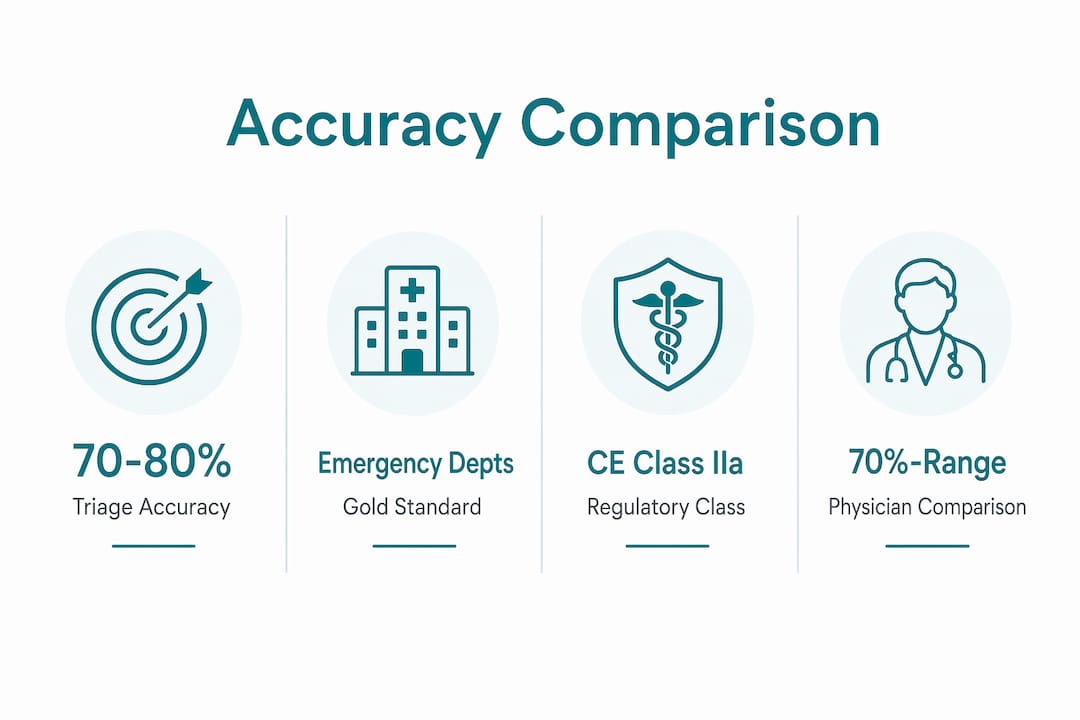
Regulatory certification is another marker of reliability. Ada Health's CE Class IIa certification requires rigorous clinical evidence of safety and performance. Non-certified tools, including many research prototypes, have not cleared that bar.
AI symptom checker comparison: Ada, K Health, Buoy, and more
The consumer AI symptom assessment market includes several distinct platforms, each with different strengths, access models, and costs. Here is how the leading options compare.
| Platform | Conversational style | Physician access | Cost | Regulatory status |
|---|---|---|---|---|
| **Ada Health** | Structured multi-question interview | No direct access | Free | CE Class IIa certified |
| **K Health** | AI + physician hybrid | Yes, on subscription | ~$49/month | Clinically validated |
| **Symptomate** | Guided symptom selection | No | Free | Clinically validated |
| **Buoy Health** | Conversational chatbot | No | Free | Not CE certified |
| **DxGPT** | Free-text AI reasoning | No | Free | Research tool |
Ada Health is the most clinically credentialed free option. Its CE Class IIa status means it has passed the same regulatory review required of medical devices in Europe. K Health takes a hybrid approach, pairing its AI triage with access to real physicians for users who need a prescription or follow-up. That combination costs around $49 per month, while basic symptom checking remains free on most platforms.
DxGPT is worth knowing about because it represents a different category entirely. It uses large language model reasoning rather than a structured medical knowledge graph. That makes it flexible but less reliable for triage. It is better suited to exploring differential diagnoses than to making urgent care decisions.
Symptomate sits between Ada and Buoy in terms of structure. It uses guided symptom selection, which keeps input controlled, but it lacks Ada's regulatory credentials.
Pro Tip: If you are in Canada and want a free, no-signup option that also shows regional wait times and connects you to the right specialist, Healthnavigatorai's MediGuide is built specifically for that use case. Check the private online medical assessment guide for more context on privacy-first tools.
What are the real benefits and limitations of AI symptom assessment?
AI symptom assessment tools serve as an intelligent front door to healthcare. Health tech analysts in 2026 emphasize this role specifically because it reduces strain on frontline medical teams by filtering out cases that do not need emergency attention.
The practical benefits are concrete:
- Faster triage decisions: You get an urgency recommendation in minutes, not hours.
- 24/7 availability: No appointment needed. You can assess symptoms at 2 a.m. on a Sunday.
- Reduced unnecessary ER visits: When a tool correctly identifies a self-care case, it keeps emergency rooms available for genuine emergencies.
- Specialist routing: Platforms like Healthnavigatorai's MediGuide connect you to the right type of specialist based on your symptoms, not just a generic "see a doctor" recommendation.
- Healthcare access in underserved areas: For Canadians in rural regions or territories with long wait times, these tools provide structured guidance that was previously unavailable without traveling.
The limitations are equally real. The most common problem is misuse. Users frequently misconstrue AI assessment as a definitive diagnosis. It is not. The tool tells you the probability of several conditions and the urgency of your situation. A physician still needs to examine you, order tests, and make the final call.
Privacy is another consideration. Some platforms collect and store your symptom data. Before using any tool, check whether it sells data to third parties. Healthnavigatorai's MediGuide does not sell or share personal data, which matters if you are searching for anonymous health search options as a Canadian user.
Advanced hybrid models that integrate medical knowledge graphs with real-time clinical data are improving triage accuracy by over 23% compared to baseline AI. That improvement comes from combining static medical knowledge with live patient data, a direction the field is moving toward quickly.
Key takeaways
AI symptom assessment tools are most valuable when used as structured triage aids, not as replacements for clinical diagnosis.
| Point | Details |
|---|---|
| Agentic interviewing drives accuracy | Multi-step AI questioning outperforms simple input, with a 2.56 odds ratio advantage over standard clinician comparison. |
| Triage accuracy reaches 70–80% | Leading platforms match emergency physician triage accuracy for top differential diagnoses. |
| Regulatory certification signals reliability | CE Class IIa certified tools like Ada Health have cleared clinical evidence requirements that unverified tools have not. |
| These tools triage, they do not diagnose | AI symptom checkers recommend care pathways. Only a licensed clinician provides a final diagnosis. |
| Privacy varies by platform | Check data-sharing policies before use. Tools like Healthnavigatorai's MediGuide do not sell or share personal health data. |
Why I think most people are using these tools wrong
I have spent years watching how people interact with health technology, and the pattern is consistent. Someone types in their symptoms, gets a list of possible conditions, and immediately fixates on the worst one. That is not how these tools are designed to be used.
The real value of AI symptom assessment is in the urgency tier, not the condition list. When a tool tells you "this looks like a self-care situation," that is clinically meaningful information backed by probabilistic reasoning across hundreds of conditions. When it tells you "go to urgent care today," that recommendation is based on the same logic that a triage nurse uses. The condition list is a starting point for a conversation with your doctor, not a self-diagnosis.
What I find genuinely exciting about the 2026 research is the hybrid AI models combining knowledge graphs with live clinical data. That architecture is the difference between a static reference book and a system that learns from real patient outcomes in real time. The accuracy gains are not marginal. They are structural improvements.
My advice is to treat AI symptom assessment the way you would treat a knowledgeable friend who happens to have medical training. They can tell you whether to worry and where to go. They cannot examine you. Use the tool for what it does well, then follow through with a real clinician when the urgency tier calls for it. The tools that earn your trust are the ones with regulatory credentials, transparent confidence levels, and clear data privacy policies. Everything else is a starting point, not a finish line.
> — Rishi
Try AI symptom assessment with Healthnavigatorai's MediGuide
Healthnavigatorai built MediGuide specifically for Canadians who need fast, clear health guidance without the friction of sign-ups, fees, or privacy trade-offs. You describe your symptoms or upload a medical document, and MediGuide delivers a plain-English assessment with your recommended next steps, the right specialist type, and average wait times for your region.
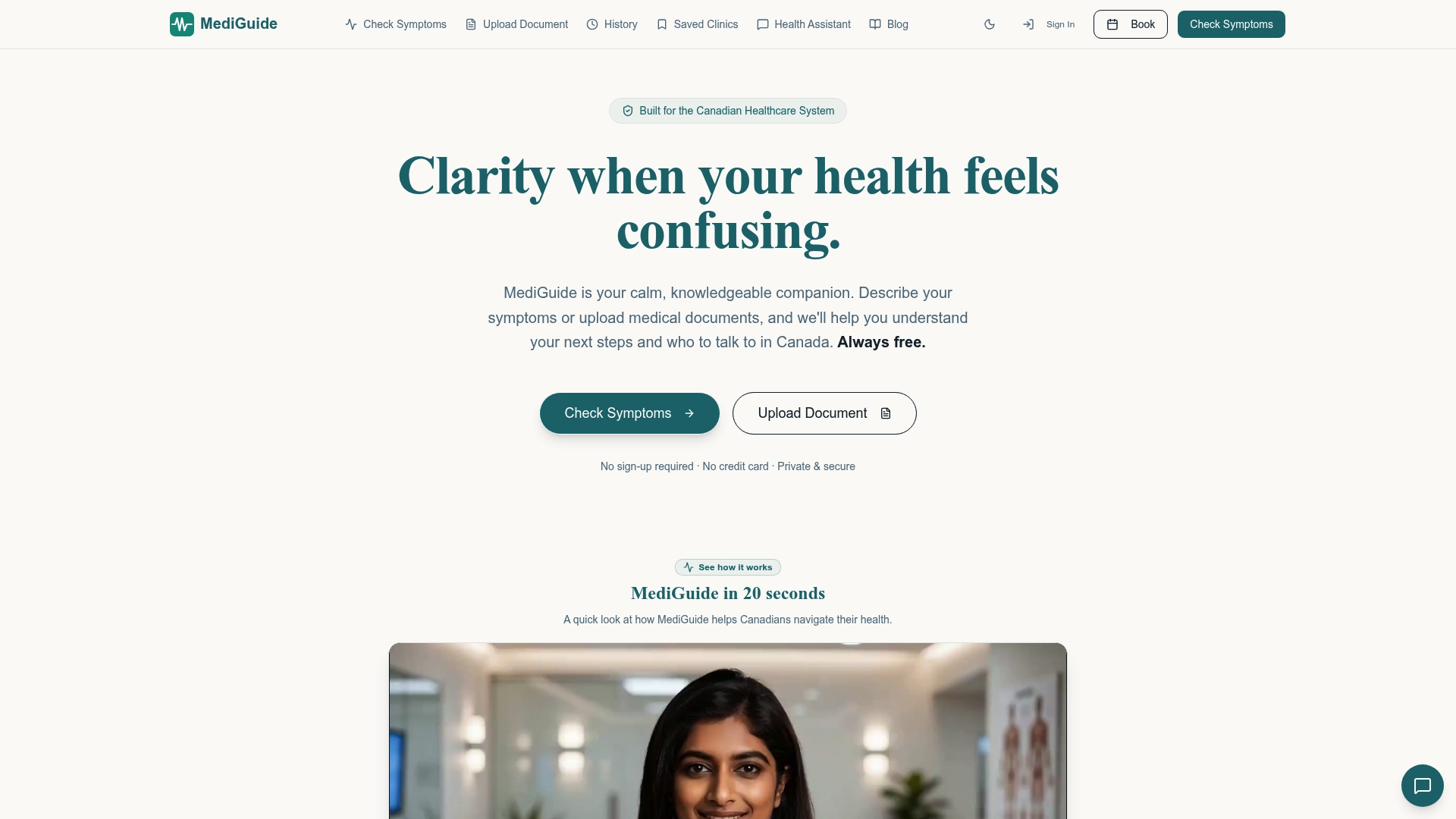
MediGuide is entirely free and requires no account. Your data is never sold or shared. If you want to put the AI symptom assessment process described in this article to work for your own health question, check your symptoms now and get a clear answer in minutes. You can also learn more about why MediGuide is built differently from other health platforms.
FAQ
What is AI symptom assessment in simple terms?
AI symptom assessment is an automated process where artificial intelligence analyzes the symptoms you report and recommends how urgently you need care. It uses machine learning and structured questioning to rank possible conditions by probability.
Can an AI symptom checker replace a doctor?
No. AI symptom checkers provide triage guidance and suggest possible conditions, but only a licensed clinician can examine you, order tests, and make a final diagnosis.
How accurate are AI symptom assessment tools?
Leading platforms reach 70–80% triage accuracy, comparable to emergency physician triage. Agentic AI interviewing methods show an odds ratio of 2.56 over standard clinician comparison in recent research.
Are AI symptom checkers safe to use for privacy?
Safety depends on the platform. Some tools collect and sell symptom data. Healthnavigatorai's MediGuide maintains strict privacy protocols and does not sell or share personal health information.
What makes one AI symptom checker better than another?
Regulatory certification, clinical validation, and the quality of the questioning method are the key differentiators. CE Class IIa certified tools like Ada Health have cleared formal clinical evidence requirements that most free tools have not.


