

Professional symptom evaluation is defined as a structured clinical process in which a qualified healthcare provider assesses your symptoms using standardized tools, physical examination, and diagnostic testing to reach an accurate diagnosis. Why symptoms need professional evaluation becomes clear the moment you realize that the human body rarely sends simple, single-cause signals. Medical guidelines as of april 2026 advise seeing a professional when symptoms are persistent, worsening, or recurring, or when they affect daily functioning. The Edmonton Symptom Assessment System, a leading clinical tool used in over 52% of symptom burden studies, demonstrates that accurate evaluation requires measuring multiple dimensions at once, not just checking off a list. Healthnavigatorai exists to help Canadians take that first step with confidence.
What clinical evidence supports professional evaluation of symptoms?
Clinical evidence consistently shows that professional evaluation catches what self-assessment misses. The Edmonton Symptom Assessment System quantifies symptom burden on standardized scales, giving clinicians objective data to guide care decisions and adjustments. That objectivity matters because patients often underreport or misread their own symptom severity.
A large-scale 2026 analysis confirmed that the Edmonton Symptom Assessment System appears in over 52% of symptom burden studies, making it the most validated tool in clinical symptom research. That prevalence reflects a professional consensus: structured measurement produces better outcomes than informal self-reporting.
Professional evaluation also goes beyond a simple symptom checklist. Clinicians assess quality of life, functional capacity, and psychological state alongside physical complaints. This multidimensional approach reveals patterns that a single symptom search never could.
- Symptom severity: Standardized scales capture intensity that patients often struggle to describe verbally.
- Functional impact: Clinicians assess how symptoms affect sleep, work, and social life, not just how they feel.
- Symptom clusters: Professionals identify groups of co-occurring symptoms that point to specific conditions.
- Trajectory: Clinicians track whether symptoms are stable, improving, or worsening over time.
Researchers stress that patient empowerment shifts symptom management from isolated data collection to ongoing collaborative clinical relationships. That shift means you are an active participant in your care, not just a data point.
Pro Tip: Ask your doctor to show you the symptom scale they are using. Understanding your own score on a tool like the Edmonton Symptom Assessment System helps you track changes between visits and communicate more clearly.
How does professional evaluation prevent misdiagnosis from self-diagnosis?
Self-diagnosis is the single biggest source of delayed treatment for Canadians with complex symptoms. When people search symptoms online, they tend to land on the most alarming possibilities, not the most probable ones. Self-diagnosis of neurological or mental health symptoms often leads to alarmist conclusions and delayed appropriate treatment.
Neurologist Dr. Luis Compres-Brugal puts it directly:
> "Professional evaluation reduces the 'burden of the unknown' and corrects the misinterpretation that patients develop when they self-diagnose. Many conditions that look identical online require completely different treatments."
Neurological symptoms are a clear example of why clinical context is irreplaceable. Many diseases mimic symptoms of multiple sclerosis, including vitamin deficiencies, Lyme disease, and anxiety disorders. A person searching "numbness and fatigue" online may convince themselves they have MS when the actual cause is a treatable B12 deficiency. Proper diagnosis requires imaging and clinical context that no search engine provides.
Mental health symptoms carry the same risk. Psychiatrist Dr. Khurana notes that medication alone does not treat all psychiatric conditions and stresses the importance of layered diagnostic weighting. A clinician can identify whether low mood stems from depression, a thyroid disorder, or a medication side effect. Those three causes require three completely different treatment paths.
Professionals also uncover hidden causes that laypeople cannot detect. An electrolyte imbalance, for example, can mimic depression with near-perfect accuracy. Lab tests and clinical synthesis reveal that underlying context. No symptom checker or internet search replicates that process.
The practical risks of self-diagnosis include:
- Choosing the wrong treatment based on a misidentified condition
- Delaying care while symptoms worsen
- Increasing health anxiety through repeated online searching
- Missing a treatable underlying cause that requires specific testing
Pro Tip: If you find yourself searching the same symptoms repeatedly online, that pattern itself is a signal to book a clinical appointment. Repeated searching rarely reduces anxiety. A professional evaluation does.
What symptoms specifically require a professional health evaluation?
Certain symptom characteristics make professional assessment non-negotiable. Symptoms that feel "out of character" particularly warrant clinical evaluation, even when they seem mild. That phrase is clinically meaningful: your baseline matters, and a doctor can compare your current state against it.
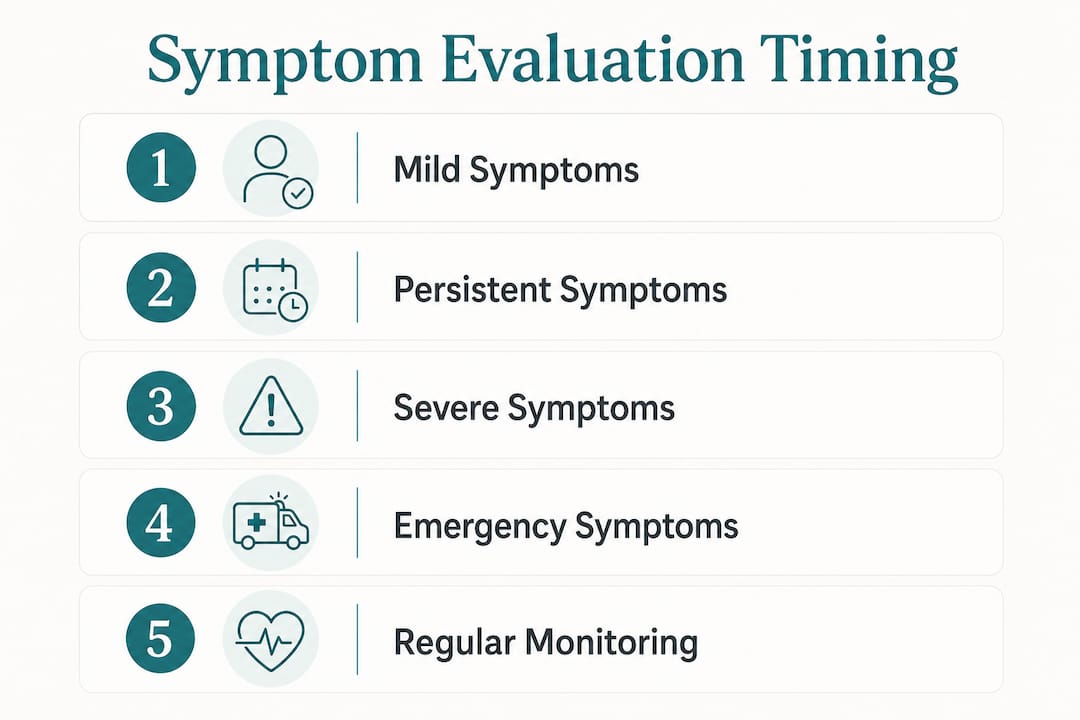
The following symptom types require professional attention:
- Persistent symptoms: Any symptom lasting more than two to three weeks without a clear cause
- Worsening symptoms: Symptoms that are getting worse rather than resolving on their own
- Recurring symptoms: Symptoms that come and go but keep returning
- Functionally impairing symptoms: Anything that disrupts sleep, work, or daily activities
- Sudden severe symptoms: Chest pain, severe headache, sudden vision changes, or limb weakness
Persistent or worsening symptoms that interfere with function require professional evaluation even when they seem mild or sporadic. Mild does not mean insignificant. A low-grade fever that persists for three weeks tells a different clinical story than a high fever lasting two days.
| Symptom type | Recommended timing |
|---|---|
| Chest pain or pressure | Same day or emergency |
| Sudden severe headache | Same day or emergency |
| Neurological changes (vision, speech, balance) | Same day or emergency |
| Persistent fatigue lasting 2+ weeks | Within one week |
| Recurring digestive issues | Within two weeks |
| Mood changes affecting daily function | Within two weeks |
| Mild symptoms lasting 3+ weeks | Within one month |
Documenting your symptoms before your appointment dramatically improves evaluation accuracy. A detailed symptom timeline, including start dates, frequency, and triggers, greatly improves evaluation efficiency and helps clinicians reach accurate conclusions faster.
Pro Tip: Keep a simple notes app entry for each symptom episode. Record the date, duration, severity on a scale of 1–10, and any possible triggers. Three weeks of that data gives your doctor more to work with than a verbal summary ever could.
How do professional evaluations guide treatment and improve outcomes?
Professional evaluation does not end at diagnosis. It creates the foundation for a treatment plan that accounts for your full clinical picture. Advanced physician-led evaluations include comprehensive biomarker testing, imaging, and personalized clinical action plans that surpass routine physicals. That depth of assessment enables early detection of silent conditions that drive symptoms without obvious cause.
The process of translating evaluation into treatment follows a clear sequence:
- Biological assessment: Lab work, imaging, and physical examination identify measurable abnormalities.
- Psychological assessment: Clinicians screen for mood disorders, anxiety, and cognitive changes that amplify physical symptoms.
- Social assessment: Factors like work stress, housing instability, and social isolation affect both symptom severity and treatment adherence.
- Differential diagnosis: Clinicians rule out conditions that mimic the primary complaint before settling on a diagnosis.
- Coordinated care: Complex symptoms often require referrals to specialists, and a primary evaluation creates the referral pathway.
Professional evaluations incorporate biological, psychological, and social information to differentiate primary problems from side effects or overlapping conditions. That integration is what separates a clinical diagnosis from a Google result.
Symptom management is increasingly a dynamic, collaborative process combining digital tools with multi-disciplinary care teams. Patients contribute actively in clinical frameworks rather than just reporting data points. That shift means your evaluation is not a one-time event. It is the start of an ongoing relationship between you and your care team, with your symptoms tracked and reassessed as treatment progresses.

Understanding how body systems signal illness helps you communicate more clearly with your care team and recognize when a new symptom warrants a follow-up visit.
Key Takeaways
Professional symptom evaluation is the most reliable path to accurate diagnosis, appropriate treatment, and better health outcomes for Canadians with persistent or impactful symptoms.
| Point | Details |
|---|---|
| Evaluation beats self-diagnosis | Self-diagnosis frequently leads to wrong conclusions; clinical tools like ESAS provide objective, validated measurement. |
| Symptoms with function impact need care | Any symptom disrupting sleep, work, or daily life warrants professional assessment, even if mild. |
| Timing matters | Chest pain and neurological changes require same-day evaluation; persistent mild symptoms need attention within a month. |
| Document before you go | A symptom timeline with dates, severity, and triggers improves clinical accuracy and speeds up diagnosis. |
| Evaluation drives treatment | Clinicians integrate biological, psychological, and social factors to build treatment plans that self-assessment cannot produce. |
My take on why professional evaluation still wins in 2026
I have watched a clear pattern repeat itself: people spend weeks searching symptoms online, building a case for a diagnosis they found at 2 AM, and then arrive at a clinic already convinced they know the answer. The problem is not that they are wrong to be concerned. The problem is that certainty without clinical evidence delays the right treatment.
What professional evaluation actually does, and what most people underestimate, is reduce the anxiety that comes from not knowing. A clinician who rules out MS through imaging does more for a patient's mental state than any reassuring article. That "burden of the unknown," as Dr. Compres-Brugal describes it, is a real clinical problem. Uncertainty makes symptoms feel worse.
Technology is genuinely useful here. Tools like Healthnavigatorai help Canadians organize their symptoms, understand what they might mean, and figure out which type of specialist to see. That is a real service. But digital tools work best as a preparation step, not a replacement for clinical judgment. The nuance that a clinician brings, reading your face, noticing what you did not mention, ordering the test you did not know to ask for, is not replicable by any algorithm in 2026.
My honest advice: use digital tools to prepare, then show up to your appointment with a written symptom timeline and a clear question. That combination produces better outcomes than either approach alone.
> — Rishi
Healthnavigatorai: a practical first step for Canadians
Knowing when to seek care is half the challenge. Healthnavigatorai gives Canadians a free, private way to describe their symptoms and receive a clear, evidence-based assessment of what those symptoms might mean and which specialist to see next.

No sign-up is required, and no personal data is stored or shared. Healthnavigatorai also provides average wait times by region, so you can plan your care realistically. Use the symptom checker as your starting point, then bring those results to your clinical appointment. Combining AI-powered assessment with professional evaluation gives you the clearest possible picture of your health. You can also upload a medical document to get plain-English guidance on what your existing test results mean before your next visit.
FAQ
Why can't I just rely on online symptom searches?
Online searches surface the most alarming possibilities, not the most probable ones. Professional evaluation uses standardized clinical tools and lab testing to identify the actual cause of your symptoms.
What does "professional health evaluation" actually include?
A professional health evaluation includes physical examination, a structured symptom history, lab work, and sometimes imaging. Clinicians also assess psychological and social factors that affect your health.
How do I know when my symptoms need medical attention?
Seek care when symptoms are persistent for more than two to three weeks, worsening, recurring, or interfering with sleep, work, or daily activities. Chest pain, sudden severe headache, and neurological changes require same-day evaluation.
Can a doctor really find something I missed on my own?
Clinicians routinely identify causes that patients cannot detect, such as electrolyte imbalances that mimic depression or vitamin deficiencies that mimic neurological disease. Lab tests and clinical context reveal what symptom searches cannot.
Does Healthnavigatorai replace a doctor's evaluation?
Healthnavigatorai is a preparation and guidance tool, not a clinical replacement. It helps you understand your symptoms and identify the right type of specialist, so your professional evaluation is more focused and productive.


