

You can understand your doctor's medical report language by learning three things: how reports are structured, what common medical terms and abbreviations mean, and how to read lab and imaging results in context. That's the whole framework. Everything else is detail.
Medical reports are written for clinicians, not patients. They use Latin-rooted terminology, shorthand abbreviations, and structured formats that assume a clinical reader. But the language follows predictable patterns, and once you recognize those patterns, a report that looked like a foreign document starts to make sense.
Here's a quick-start approach before you read further:
- Start with the "Impression" or "Assessment" section. That's where the doctor's conclusion lives. Read it first, then work backward.
- Note which results are flagged as abnormal. Labs and reports mark these with "H" (high), "L" (low), or an asterisk. Normal results rarely need immediate attention.
- Look up unfamiliar terms using trusted resources like MedlinePlus before assuming the worst.
- Write down questions as you read. Bring them to your next appointment.
- Use AI translation tools like Patiently AI or Radlii to convert dense clinical language into plain English before your visit.
Pro Tip: Use an AI tool like Patiently AI to generate a plain-language summary of your report, then write two or three specific questions from that summary. Patients who arrive with written questions consistently get more useful answers from their doctors.
Healthnavigatorai exists precisely for this kind of moment. When a report lands in your inbox and you're not sure what it means, you shouldn't have to decode it alone.
Common sections and structure of medical reports explained
Most medical reports follow a predictable structure, even when the specialty changes. Knowing what each section is supposed to contain tells you where to look for the information you actually need.

Patient information and clinical history appear at the top. This section confirms who the report is about, the date of the encounter, and the reason for the test or visit. It's worth checking this section first to confirm the report belongs to you and reflects the correct visit.
Examination findings or observations describe what the clinician observed directly, whether through physical exam, imaging, or laboratory analysis. This section tends to be the most technical, filled with measurements, anatomical references, and descriptive terms. Don't try to interpret every word here on your first read.
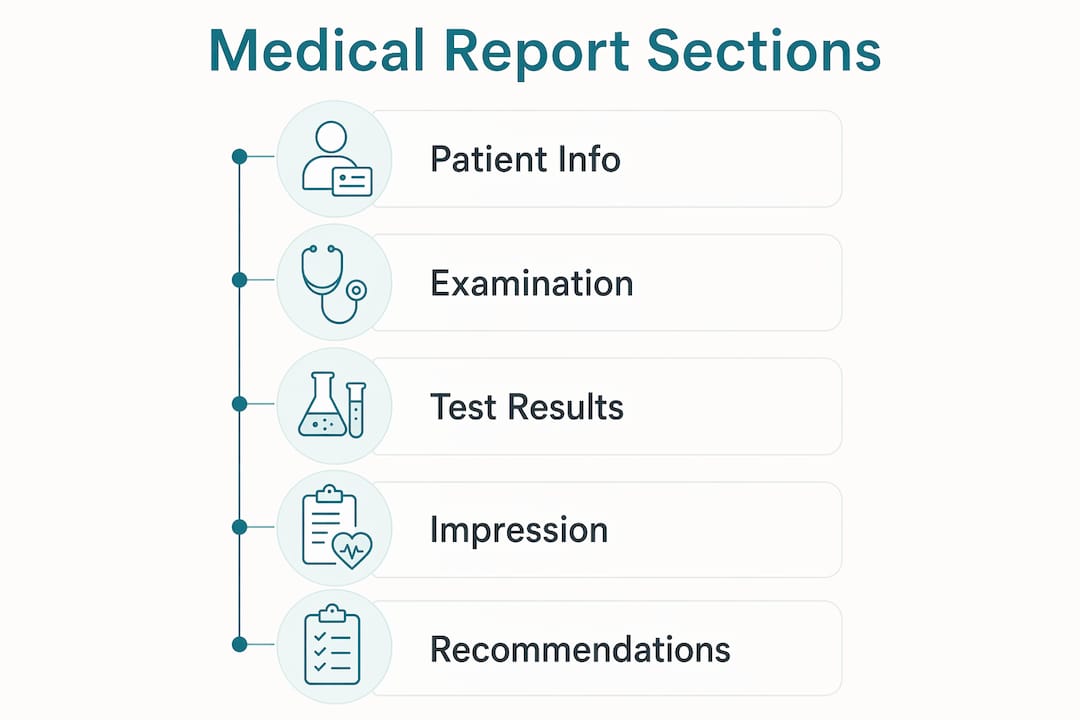
Test results or laboratory data present the actual numbers or findings from any tests ordered. Labs usually include a reference range alongside each value so you can see at a glance whether a result falls inside or outside the expected band.
Impression or assessment is the section that matters most to most patients. This is where the clinician states their interpretation of the findings. It may read as a diagnosis, a differential (a list of possible diagnoses ranked by likelihood), or a statement that findings are within normal limits.
Recommendations or plan outlines what happens next: follow-up tests, referrals, medications, or a note that no further action is needed.
Here's what each section typically answers:
- Patient info: Is this report about me, and does the date match my visit?
- Clinical history: Why was this test or exam ordered?
- Findings: What did the clinician observe or measure?
- Impression: What does the clinician think it means?
- Recommendations: What should happen next?
Pro Tip: If your report has no "Impression" section, look for "Conclusion," "Summary," or "Assessment." Different specialties use different labels for the same concept.
One distinction worth knowing: diagnostic language identifies or rules out a condition ("consistent with mild anemia"), while treatment language describes what to do about it ("initiate iron supplementation"). You'll often see both in the same report, but they serve different purposes and carry different weight.
How to interpret medical terminology and abbreviations in reports
Medical terminology is not random. Most terms are built from Greek and Latin word parts, which means learning common roots gives you a reusable decoding skill rather than a list of isolated words to memorize.
The three building blocks are prefixes (before the root), roots (the core meaning), and suffixes (after the root). A term like "tachycardia" breaks into "tachy" (fast) + "cardi" (heart) + "ia" (condition of). You don't need a medical degree to work that out once you know the parts.
| Word Part | Meaning | Example |
|---|---|---|
| hypo- | below normal | hypoglycemia (low blood sugar) |
| hyper- | above normal | hypertension (high blood pressure) |
| -itis | inflammation | appendicitis (inflamed appendix) |
| -ectomy | surgical removal | appendectomy (removal of appendix) |
| cardi/o | heart | cardiomegaly (enlarged heart) |
| hepat/o | liver | hepatitis (liver inflammation) |
| -ology | study of | cardiology (study of the heart) |
| brady- | slow | bradycardia (slow heart rate) |
Common abbreviations show up constantly in doctor notes and reports. A few you'll encounter often:
- Hx = history
- Dx = diagnosis
- Rx = prescription or treatment
- PRN = as needed
- SOB = shortness of breath
- WNL = within normal limits
- c/o = complains of
- f/u = follow-up
- b.i.d. = twice daily
- q.d. = once daily
Tips for breaking down unfamiliar terms:
- Split the word at recognizable parts. Start with the suffix, then the prefix, then the root.
- Search the term on MedlinePlus or GlobalRPH's medical terminology reference before assuming a serious meaning.
- If a term appears in the "Impression" section, prioritize looking it up. Terms buried in "Findings" are often descriptive rather than conclusive.
- Ask your pharmacist. They decode medical terminology daily and are often more accessible than a physician for quick questions.
Pro Tip: Write unfamiliar terms phonetically in your notes so you can say them aloud to your doctor. Mispronouncing a term is far better than avoiding the conversation entirely.
Understanding lab test results: reference ranges and what your numbers mean
Reference ranges are the numbers printed next to your result that define what's considered normal for a given test. They're calculated from large groups of healthy people, which means they represent a statistical average, not a personal guarantee. A result slightly outside the range doesn't automatically mean something is wrong.
Labs set their own reference ranges based on their equipment and the populations they serve. This is why you can't compare results from two different labs directly, and why the range printed on your report is the only one that applies to your result.
| Lab Test | Common Reference Range | What It Measures | Plain-Language Note |
|---|---|---|---|
| Hemoglobin | a lab-specific reference range | Oxygen-carrying protein in red blood cells | Low may suggest anemia; high can indicate dehydration |
| Fasting glucose | a lab-specific reference range | Blood sugar level | High levels may indicate diabetes |
| LDL cholesterol | a lab-specific reference range | "Bad" cholesterol | Higher levels associated with cardiovascular risk |
| TSH | a lab-specific reference range | Thyroid function | Outside range may signal thyroid overactivity or underactivity |
| Creatinine | a lab-specific reference range | Kidney waste filtration | Elevated levels may suggest reduced kidney function |
Result statuses you'll see on lab reports:
- Negative or normal: The test didn't find what it was looking for. You're unlikely to have the condition tested for, though further testing may still be needed.
- Positive or abnormal: The substance, germ, or gene being tested was found. This may indicate a disease or infection, but often requires confirmation.
- Inconclusive: The result wasn't clearly positive or negative. Retesting is usually recommended.
- False positive: The test flagged a condition you don't actually have.
- False negative: The test missed a condition you do have.
Lab results should never be interpreted in isolation. Your clinical history, symptoms, medications, and recent activity all affect what a number means. A hemoglobin reading that looks low on paper might be completely appropriate for your body, or it might need urgent attention. Only your provider can tell the difference.
Pro Tip: Before your lab appointment, tell your provider about every supplement and over-the-counter medication you take. Certain vitamins, iron supplements, and even biotin can skew results in ways that lead to unnecessary follow-up testing.
Several everyday factors can affect lab accuracy: what you ate or drank, recent intense exercise, your menstrual cycle, and whether you followed fasting instructions. MedlinePlus lists these factors explicitly, and your provider should walk you through any preparation requirements before the test.
How to read your radiology and imaging reports
Radiology reports are written by radiologists for the ordering physician, which means the language is dense, highly technical, and assumes the reader can visualize the anatomy being described. Patients who receive these reports directly through a patient portal often find them the most alarming to read, partly because the terminology is unfamiliar and partly because radiologists document everything they see, including incidental findings that may have no clinical significance.

The report typically has three parts: Findings, Impression, and sometimes Technique or Clinical Information at the top. The Findings section describes what the radiologist observed in the images. The Impression section is the radiologist's interpretation and is the part your doctor reads first.
| Report Section | What it contains | What to focus on |
|---|---|---|
| Technique | Imaging method used (e.g., contrast vs. no contrast) | Confirms what type of scan was done |
| Clinical information | Reason the scan was ordered | Provides context for findings |
| Findings | Detailed description of observed structures | Dense; read carefully but don't panic at length |
| Impression | Radiologist's conclusions and recommendations | Read this first; it's the summary |
Patiently AI translates discharge summaries, lab results, and imaging reports into clear, patient-friendly language without replacing medical advice. Radlii takes a similar approach specifically for imaging reports, with plain-language translations written by experienced radiologists. Both tools are worth using before your follow-up appointment.
Things to look for in a radiology report:
- "No acute findings" means nothing urgent was detected. This is generally reassuring.
- "Incidental finding" refers to something observed that wasn't the focus of the scan. It may or may not be clinically relevant.
- "Recommend clinical correlation" means the radiologist wants your doctor to connect the imaging finding to your symptoms and history.
- "Follow-up imaging recommended" suggests the finding needs monitoring, not necessarily treatment.
- Laterality terms like "right," "left," "bilateral," "ipsilateral" (same side), and "contralateral" (opposite side) tell you where a finding is located.
Pro Tip: AI tools like Patiently AI and Radlii explain the text of your report, but they don't access the actual scan images. A radiologist reading the images directly may catch nuances that a text-only translation misses. Always discuss imaging findings with your ordering physician.
AI medical translation tools clarify language but lack the full clinical picture. They're preparation tools, not diagnostic ones.
Tips for using your medical report to communicate effectively with your doctor
Arriving at an appointment with your report already read, even partially, changes the quality of the conversation. Doctors have limited time, and a patient who can point to a specific section and ask a focused question gets more useful information than one who says "I didn't understand any of it."
Practical strategies for better appointments:
- Annotate your report before you go. Circle or highlight terms you don't understand and write your question next to each one.
- Bring a plain-language translation. If you used Patiently AI or a similar tool to get a simplified version, print it or pull it up on your phone. It gives you and your doctor a shared starting point.
- Ask about the "Impression" section specifically. If the report says "findings are consistent with X," ask your doctor what that means for your treatment plan.
- Request written clarification. Ask your provider to write down the diagnosis, the next steps, and any follow-up timeline. Memory under stress is unreliable.
- Don't self-diagnose from the report. Use the report to ask better questions, not to reach conclusions.
Conversation starters that actually work:
- "The report mentions [term]. Can you explain what that means for me specifically?"
- "The impression says [finding]. Is that something we need to act on now, or monitor over time?"
- "Are there any results here that concern you? Are there any that you'd consider reassuring?"
- "What would change if this result were different?"
Pro Tip: Keep a running health journal with one page per visit. Write the date, the report findings in plain language, your doctor's verbal explanation, and the agreed next steps. Over time, this becomes an invaluable personal health record that no portal can replicate.
You can also translate prescription instructions into plain English using Healthnavigatorai's resources, which pairs well with understanding what your report recommends.
How to verify information with your healthcare provider for clarity
Getting a confusing result and sitting with it alone is one of the most common sources of health anxiety. The fix is direct verification, and most patients underestimate how willing providers are to clarify when asked directly.
Start by contacting your provider's office through the patient portal or by phone. Most practices have a nurse line specifically for questions about test results. You don't need to wait for a full appointment to ask whether a flagged result is something that needs urgent attention.
When you do speak with your provider, be specific. "I have a question about my report" is less effective than "My CBC shows my hemoglobin is flagged as low at 11.2. Is that something we need to address now?" Specificity signals that you've engaged with the report and helps your provider give a targeted answer.
If you receive a report through a patient portal before your provider has reviewed it, resist the urge to interpret it alone. Portals like MyChart release results automatically, sometimes before the ordering physician has had a chance to add context. A flagged result in your portal is not a diagnosis. It's a data point waiting for clinical interpretation.
Secondary opinions are also a legitimate form of verification. If a report contains a finding that feels significant and your provider's explanation doesn't satisfy you, asking for a referral to a specialist is a reasonable next step, not an overreaction.
Common phrases and cautions that indicate urgency or non-urgency
Medical reports use specific language to signal how serious a finding is. Learning to read these signals prevents both unnecessary panic and missed urgency.
Phrases that typically indicate urgency:
- "Critical value" or "panic value": A result so far outside the normal range that it requires immediate clinical attention. Labs are required to call the ordering provider directly when these appear.
- "Acute": Sudden onset, often requiring prompt evaluation.
- "Emergent" or "urgent referral recommended": The radiologist or clinician believes the finding needs rapid follow-up.
- "Mass," "lesion," or "nodule" with no prior comparison: These terms describe abnormal tissue and typically prompt further imaging or biopsy, though they do not automatically mean cancer.
- "Occlusion" or "obstruction": A blockage, which depending on location can be a medical emergency.
Phrases that typically indicate non-urgency:
- "Within normal limits" (WNL): The finding is considered normal.
- "No acute findings": Nothing requiring immediate action was detected.
- "Stable" or "unchanged from prior": A known finding has not progressed.
- "Incidental finding, likely benign": Something was noticed that is probably not harmful and may just need monitoring.
- "Recommend routine follow-up": The provider suggests a standard check-in, not an urgent one.
- "Clinical correlation recommended": The radiologist wants your doctor to connect the imaging to your symptoms. This is standard language, not a red flag.
One phrase that confuses many patients is "cannot exclude." When a report says "cannot exclude malignancy," it means the imaging alone isn't sufficient to rule it out, not that cancer is likely. It's a radiologist's way of being thorough, and it almost always leads to additional testing rather than a diagnosis.
How to differentiate between diagnostic, prognostic, and treatment language
Medical reports contain three distinct types of language, and mixing them up leads to misinterpretation. Knowing which type you're reading changes how you respond to it.
Diagnostic language identifies or rules out a condition. It answers the question "What is it?" You'll see phrases like "consistent with," "findings suggestive of," "no evidence of," or "differential diagnosis includes." Diagnostic language describes what the clinician believes is happening based on available evidence. It's not always definitive. "Consistent with early osteoarthritis" means the findings fit that diagnosis, not that the diagnosis is confirmed.
Prognostic language describes the likely course or outcome of a condition. It answers "What will happen?" Phrases like "favorable prognosis," "expected to resolve," "chronic and progressive," or "risk of recurrence" are prognostic. This language appears more often in oncology and cardiology reports than in routine lab work. When you see prognostic language, it's worth asking your provider to explain the timeframe and the factors that could change the outlook.
Treatment language describes what should be done. It answers "What's next?" You'll see phrases like "initiate therapy," "surgical consultation recommended," "conservative management appropriate," or "no intervention required at this time." Treatment language in a report is a recommendation from the reporting clinician to the ordering provider. Your doctor may agree, modify, or override it based on your full clinical picture.
A single report can contain all three types. A radiology report might say "findings consistent with pulmonary embolism" (diagnostic), "requires urgent anticoagulation therapy" (treatment), and "prognosis is generally favorable with prompt treatment" (prognostic). Reading each sentence with the question "Is this identifying, predicting, or recommending?" helps you sort the information quickly.
Simplifying medical report language empowers patients to advocate for themselves, reducing diagnostic delay and unnecessary follow-up. That advocacy starts with knowing what kind of statement you're reading.
Try Healthnavigatorai to understand your next report
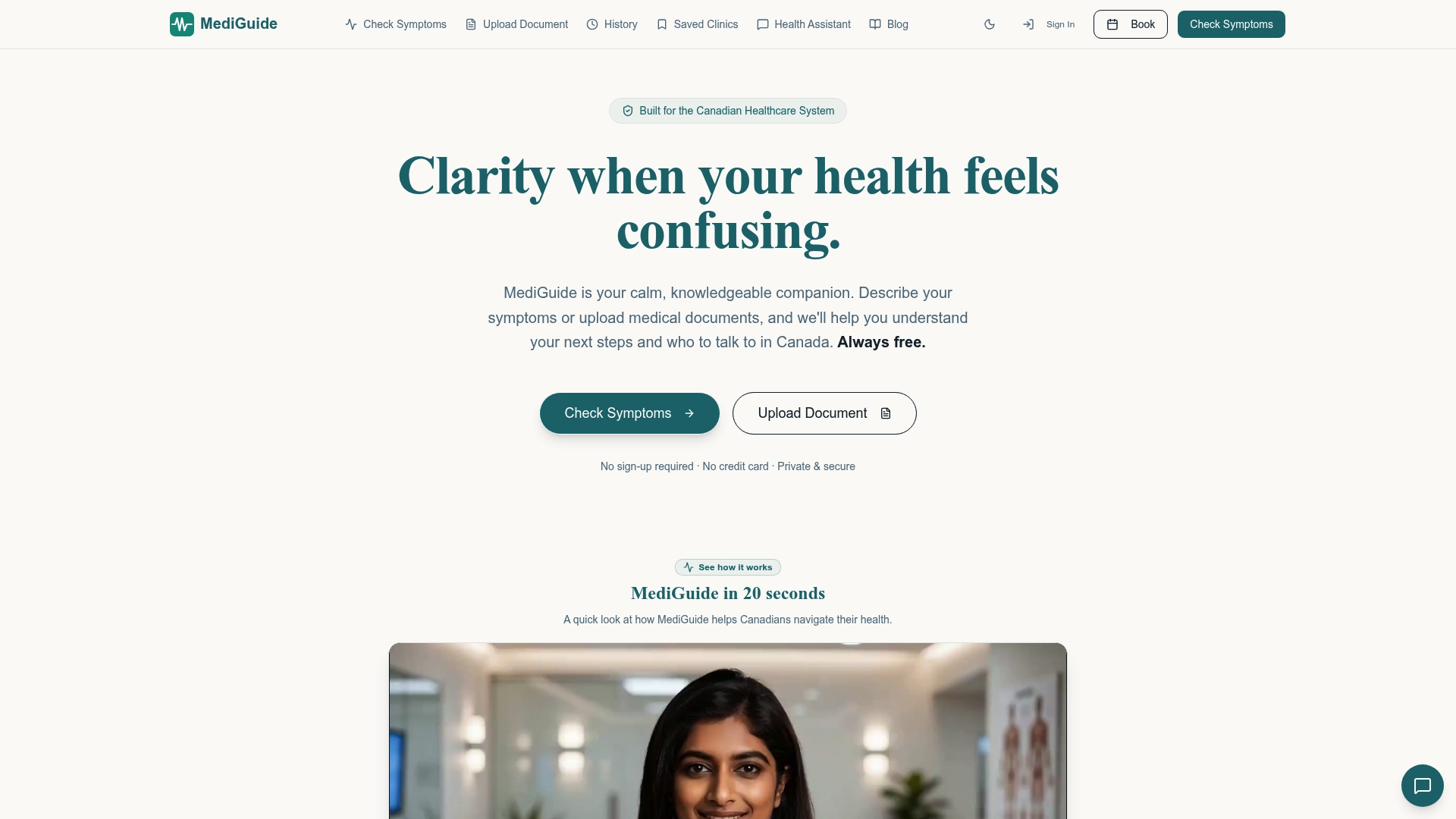
Healthnavigatorai's MediGuide lets you upload your medical document and receive a plain-language explanation instantly, with no sign-up required and no personal data stored or shared. If you're not sure what your report means or what to do next, you can also check your symptoms directly and get guidance on the right specialist and typical wait times for your area.
It's free, private, and built for exactly this situation.
Key Takeaways
Understanding doctor report language comes down to recognizing report structure, decoding medical terminology with reusable word-part strategies, and reading lab and imaging results in clinical context rather than in isolation.
| Point | Details |
|---|---|
| Read the Impression section first | The Impression or Assessment section contains the clinician's conclusion; start there before reading findings. |
| Reference ranges are statistical, not personal | A result outside the range doesn't always mean illness; clinical context determines what the number means. |
| Medical terms follow Latin and Greek patterns | Learning prefixes like "hypo-" and suffixes like "-itis" lets you decode unfamiliar terms without memorizing every word. |
| AI tools prepare you, they don't diagnose you | Patiently AI and Radlii translate report language into plain English, but they don't replace a provider's clinical judgment. |
| Diagnostic, prognostic, and treatment language are distinct | Knowing whether a sentence identifies a condition, predicts an outcome, or recommends action changes how you respond to it. |


