

Prescription instructions translation is the process of converting medical shorthand and clinical language on a pharmacy label into clear, everyday directions a patient can follow safely. For Canadians, this matters more than most people realize. Pharmacy labels use sig codes, Latin abbreviations, and vague timing phrases that routinely cause confusion. The result is missed doses, double doses, and avoidable drug interactions. This guide covers what prescription labels actually contain, which tools cut through the jargon, and how to use pharmacist counseling and the teach-back method to confirm you have it right.
What do prescription instructions actually include?
The most critical part of any prescription label is the dosing line or sig, which specifies the exact dose and timing for safe drug use. Sig codes are shorthand derived from Latin. "BID" means twice daily. "PRN" means as needed. "QHS" means at bedtime. Most patients have never seen a Latin abbreviation key, yet these codes appear on nearly every bottle.
Beyond the sig line, pharmacy labels include auxiliary warning stickers. These are the small colored labels that say things like "take with food," "avoid alcohol," or "may cause drowsiness." Auxiliary labels contain safety information that directly affects how you handle and time your medication. Ignoring them is one of the most common and preventable sources of medication error.
Many labels also reference a Patient Package Insert, or PPI. This is the folded paper insert that comes with the medication. It contains full prescribing information, drug interaction warnings, and storage instructions. Most patients discard it immediately.
- Sig line: Dose amount, frequency, and route (oral, topical, inhaled)
- Auxiliary stickers: Food, alcohol, light, and activity warnings
- Patient Package Insert (PPI): Full drug information, interactions, and storage
- Refill information: Number of refills authorized and expiry date
- Prescriber details: Doctor's name and contact for follow-up questions
Pro Tip: Before leaving the pharmacy, read the sig line out loud. If you cannot say it in plain English, ask the pharmacist to restate it before you walk out.
Vague phrases like "take as directed" or "twice daily" create real confusion. "Twice daily" does not specify whether doses should be 12 hours apart or simply morning and evening. Patient-centric label best practices call for numerals instead of words, plain timing anchors, and prominent dosing display. Most Canadian pharmacy labels do not yet meet that standard.
What tools help simplify prescription instructions?
The Universal Medication Schedule, or UMS, is the most effective tool for converting vague timing language into clear daily anchors. The UMS replaces phrases like "twice daily" or "three times daily" with specific time-of-day markers: morning, noon, evening, and bedtime. UMS time anchors improve comprehension over abstract frequency labels, particularly for patients managing multiple medications.
Here is how to apply the UMS to common frequency instructions:
- Once daily: Take in the morning unless the label specifies otherwise.
- Twice daily: Take at roughly 7 AM and 7 PM, spaced 12 hours apart, to maintain consistent drug levels.
- Three times daily: Take in the morning, early afternoon, and evening, spaced roughly 6–8 hours apart.
- Four times daily: Take at morning, noon, early evening, and bedtime.
- At bedtime (QHS): Take within 30 minutes of lying down, not simply at a fixed clock time.
The second tool is plain number use. Good translation prioritizes numerals over words and restructures information around dose and timing clarity rather than literal word-for-word conversion. Writing "take 2 tablets" is clearer than "take two tablets." Writing "take at 8 AM" is clearer than "take in the morning."
The third tool is direct pharmacist counseling. Every Canadian has the right to ask their pharmacist for a verbal explanation of their prescription. Pharmacists are trained to translate clinical language into plain directions. Prepare two or three specific questions before you pick up a new medication.

Pro Tip: Write your questions down before your pharmacy visit. Ask: "What time exactly should I take this?" and "Does food change how this works?" Specific questions get specific answers.
The teach-back method is the fourth tool. After your pharmacist explains the instructions, repeat them back in your own words. Teach-back improves medication adherence and patient self-efficacy. If you cannot repeat the instructions accurately, the pharmacist can correct the misunderstanding on the spot.
How to translate a prescription label step by step
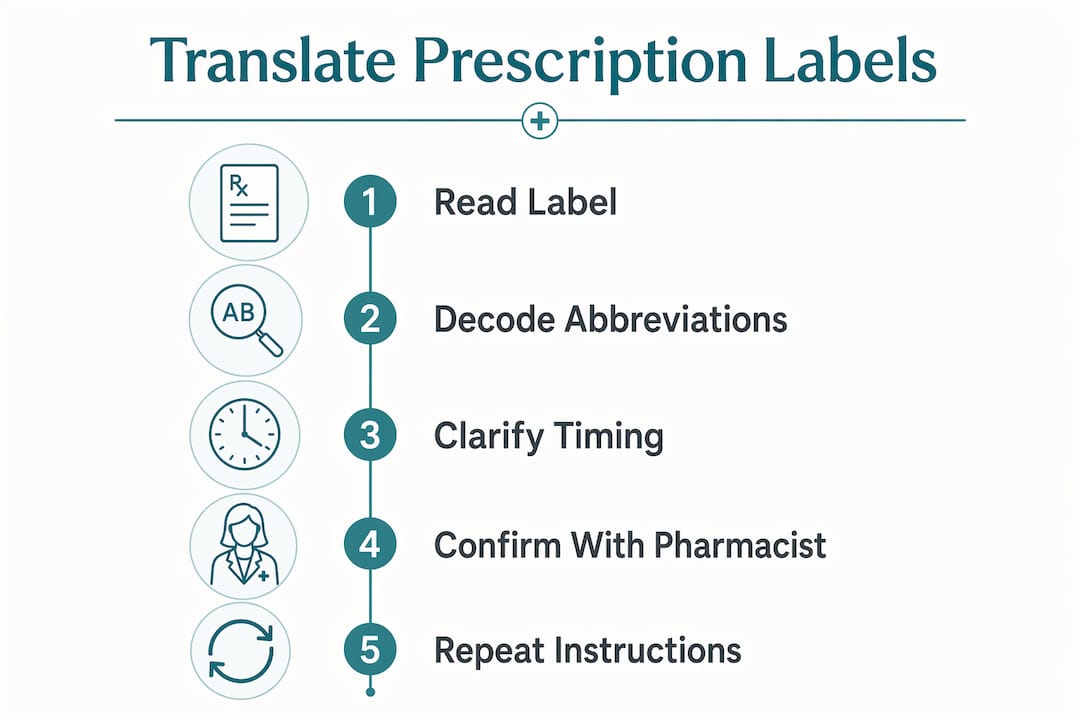
Converting a prescription label into easy to understand prescriptions takes about five minutes when you follow a consistent process. Work through the label in this order:
- Read the drug name and strength. Confirm the name matches what your doctor prescribed. Note the strength in milligrams or micrograms.
- Decode the sig line. Identify the dose amount, the frequency code, and the route. Translate each element into plain English before moving on.
- Convert timing into clock times. Use the UMS anchors above. Write the actual times on a notepad or phone calendar.
- Read every auxiliary sticker. Do not skip these. "Take with food" means take within 15–30 minutes of a meal, not just any time you happen to eat.
- Check the Patient Package Insert for interactions. Look specifically for foods, supplements, or other drugs listed under "drug interactions."
- Confirm anything unclear with your pharmacist. Omissions in timing details and vague instructions require specific follow-up questions. Harm often comes from incomplete instructions, not just translation errors.
Here is a before-and-after comparison of typical prescription language:
| Original label language | Plain English translation |
|---|---|
| Take 1 tab PO BID | Take 1 tablet by mouth at 8 AM and 8 PM |
| Take 1 cap TID with food | Take 1 capsule at breakfast, lunch, and dinner |
| Apply topically QHS PRN | Apply to skin at bedtime only when needed |
| Take 2 tabs PO QID | Take 2 tablets by mouth at 8 AM, 12 PM, 4 PM, and 8 PM |
| Take as directed | Ask your pharmacist for specific times and doses |
"Take as directed" is the most dangerous phrase on any label. It transfers all responsibility to the patient without providing any actual direction. If your label says this, treat it as incomplete and return to the pharmacy for a full verbal explanation.
Common mistakes when reading prescription instructions
The most frequent error is ignoring auxiliary warning stickers. Patients focus on the sig line and miss the colored stickers entirely. A medication labeled "avoid grapefruit" can cause serious drug interactions if that sticker goes unread.
- Skipping the PPI: The Patient Package Insert lists drug interactions and contraindications that the label itself does not have room to include.
- Relying on machine translation: Automated translations often omit key timing details and food instructions, creating real safety risks for patients who speak languages other than English.
- Assuming "twice daily" means morning and night: Without a specific time anchor, patients often take both doses within a few hours of each other, reducing effectiveness.
- Not flagging discrepancies: If your verbal instructions from the doctor differ from the bottle, ask the pharmacist to reconcile them before you take the first dose.
- Stopping early: Antibiotics and some other drug classes require a full course. "Take until finished" means exactly that, even if symptoms resolve.
> "Medication counseling is a key safety check. A pharmacist catching a 10x dispensing error before a patient leaves the counter is not rare. It is what counseling is designed to do." — ISMP Canada
When instructions remain unclear after reading the label, do not guess. Call the dispensing pharmacy directly. In Canada, pharmacists are accessible by phone and are required to provide counseling on new prescriptions. This is a right, not a favor.
How does pharmacist counseling improve medication clarity?
Medication counseling in Canada reduces medication errors by helping patients understand how and when to take their drugs and how to recognize side effects. Pharmacists are the most accessible healthcare professionals in the Canadian system. Most are available without an appointment.
When you pick up a new prescription, ask for a counseling session. Bring a list of all other medications you take, including supplements. Ask these specific questions:
- "What is this medication for, and how will I know it is working?"
- "What time of day should I take it, and does food affect it?"
- "What side effects should I watch for in the first week?"
- "Are there any drugs or foods I need to avoid?"
Pharmacists confirm understanding and adapt instructions for individual patients, making counseling a cornerstone of safe medication use. A pharmacist can also print a simplified medication schedule for you on request. Many Canadian pharmacies offer this service at no charge.
Pro Tip: Use the teach-back method at the end of every counseling session. Say: "Let me repeat that back to make sure I have it right." A teach-back conversation loop where you explain your understood schedule and receive immediate corrections is the fastest way to prevent errors.
If English is not your first language, you have the right to request translated prescription labels at many Canadian pharmacies. Human medical translators must review these translations. Machine-generated versions carry real safety risks and should not be used without pharmacist verification.
Key takeaways
Clear medication directions require reading the sig line, auxiliary stickers, and Patient Package Insert together, then confirming timing with your pharmacist using the teach-back method.
| Point | Details |
|---|---|
| Decode the sig line first | Translate Latin abbreviations into plain dose and timing language before anything else. |
| Use UMS time anchors | Replace vague frequency phrases with specific clock times tied to daily activities. |
| Never skip auxiliary stickers | Food, alcohol, and activity warnings on colored stickers directly affect medication safety. |
| Confirm with teach-back | Repeat instructions back to your pharmacist to catch misunderstandings before they cause harm. |
| Ask about machine translations | Automated label translations require human pharmacist review to be safe and complete. |
Why plain instructions matter more than most people think
Reading prescriptions for years, I have seen one pattern repeat itself constantly. Patients who miss doses or take medications incorrectly almost never do so out of carelessness. They do it because the instructions genuinely did not make sense to them.
The phrase "take as directed" should not exist on any label. It is a placeholder, not an instruction. Yet it appears on thousands of Canadian prescriptions every week. When a patient reads that phrase and does not ask for clarification, the system has failed them, not the other way around.
The teach-back method changed how I think about medication communication. Asking someone to repeat instructions back is not condescending. It is the fastest way to find out whether the information actually landed. Most misunderstandings surface in the first sentence of a teach-back. That is a good thing. Better to catch it at the counter than at the emergency room.
My strongest advice is this: treat every new prescription as incomplete until you can state the instructions out loud in plain English without looking at the bottle. If you cannot do that, you are not ready to take the medication safely. That is not a criticism. It is a standard worth holding.
> — Rishi
Healthnavigatorai makes prescription instructions clear
Healthnavigatorai offers Canadians a free, private way to get plain-English explanations of medical documents, including prescription labels. No sign-up is required, and your data is never sold or shared.
You can upload your prescription directly to Healthnavigatorai and receive a clear, plain-language breakdown of your dosing instructions, timing, and warnings. If you are unsure whether your symptoms match your current medication, the symptom checker connects you to the right specialist with average wait times for your region. Healthnavigatorai is built for Canadians who want fast, clear answers without navigating a complicated health portal.
FAQ
What does it mean to translate prescription instructions into plain English?
It means converting medical shorthand, Latin abbreviations, and clinical timing phrases on a pharmacy label into clear, specific directions you can follow without guessing. The goal is a statement like "take 1 tablet at 8 AM and 8 PM with food" instead of "take 1 tab PO BID."
How do I read the dosing line on my prescription label?
The dosing line, or sig, lists your dose amount, frequency code, and route of administration. Translate each code into plain language: BID means twice daily, TID means three times daily, and PRN means only when needed. Use prescription label guidance to work through unfamiliar abbreviations.
Why is "twice daily" confusing on a prescription?
"Twice daily" does not specify whether doses should be 12 hours apart or simply morning and evening. The Universal Medication Schedule recommends anchoring doses to specific times, such as 7 AM and 7 PM, to maintain consistent drug levels in your body.
Can I use an online translator for my prescription label?
Automated translations frequently omit timing details and food instructions, which creates safety risks. Any machine-translated label must be reviewed by a pharmacist before you rely on it for dosing decisions.
What should I ask my pharmacist about a new prescription?
Ask for the exact times to take your medication, whether food affects it, what side effects to watch for in the first week, and which drugs or foods to avoid. Use the teach-back method at the end of the conversation to confirm you have the instructions right.


