

A specialist consultation letter is a formal clinical document that a primary care provider sends to a specialist, summarizing a patient's condition and requesting focused medical assessment. This letter defines the role of specialist consultation letter in Canadian healthcare: it transfers clinical responsibility, sets the scope of the specialist's task, and protects the patient from gaps in care. Without it, specialists receive patients cold, with no context, no history, and no clear question to answer. Healthnavigatorai helps Canadians decode these letters and understand exactly what their referral means before they walk into a specialist's office.
What does a specialist consultation letter include?
A standardized referral letter format reduces the risk of missing critical data and speeds specialist diagnosis. That consistency matters because specialists rely entirely on what the referring provider sends. A disorganized or incomplete letter forces the specialist to start from scratch, which wastes your appointment time.
A well-written consultation letter covers seven to eight core components:
- Chief complaint: The main symptom or concern prompting the referral, stated clearly and without ambiguity.
- Symptom duration: How long the problem has been present, which helps the specialist gauge urgency and progression.
- Relevant medical history: Past diagnoses, surgeries, and chronic conditions that may affect the specialist's assessment.
- Current medications: A full list, including dosages, so the specialist avoids prescribing conflicting treatments.
- Allergies: Drug and environmental allergies that could affect treatment options.
- Recent test and imaging results: Lab work, X-rays, MRIs, or ultrasounds already completed, so the specialist does not repeat them.
- Specific clinical question: The single most important sentence in the letter. It tells the specialist exactly what the referring provider needs answered.
| Component | Why it matters |
|---|---|
| Chief complaint | Focuses the specialist's assessment from the first minute |
| Symptom duration | Signals whether the case is urgent or chronic |
| Current medications | Prevents dangerous drug interactions |
| Recent test results | Eliminates redundant investigations |
| Specific clinical question | Defines the specialist's task and shapes the consultation report |
Pro Tip: Before your referral is sent, ask your family doctor to read the clinical question out loud to you. If you cannot understand what is being asked, the specialist may struggle too.

Why is the consultation letter important for patients and providers?
The consultation letter does more than transfer information. It prepares the specialist for a focused assessment, which means your appointment is productive from the first minute rather than spent gathering background. A well-constructed referral allows specialists to prepare in advance, preventing inefficient consultations.
The benefits extend across every stakeholder in your care:
- For patients: You avoid repeat tests, shorter appointments, and the frustration of explaining your history from scratch.
- For specialists: They arrive at the consultation with context, a clear question, and the test results they need to give you a real answer.
- For primary care providers: The letter keeps them in the coordinator role, preventing fragmented care. This is especially critical in chronic disease management, where multiple providers must stay aligned.
- For the healthcare system: Complete referrals reduce unnecessary appointments. Up to 25% of specialist visits could be avoided if referrals were more complete. That is a significant drain on a system already under pressure.
Canadian insurance coverage adds another layer of importance. Many Canadian insurance plans require formal referral documentation before covering specialist visits. The letter is not just a clinical courtesy. It is often a financial requirement. Without it, you may face out-of-pocket costs for an appointment your plan would otherwise cover. You can review how provincial health coverage intersects with referral requirements to understand what applies in your province.
High-quality referral letters also build professional trust between providers. When a specialist receives a thorough, well-organized letter, they treat the referring provider as a reliable clinical partner. That trust translates into faster responses, clearer consultation reports, and better care for you.
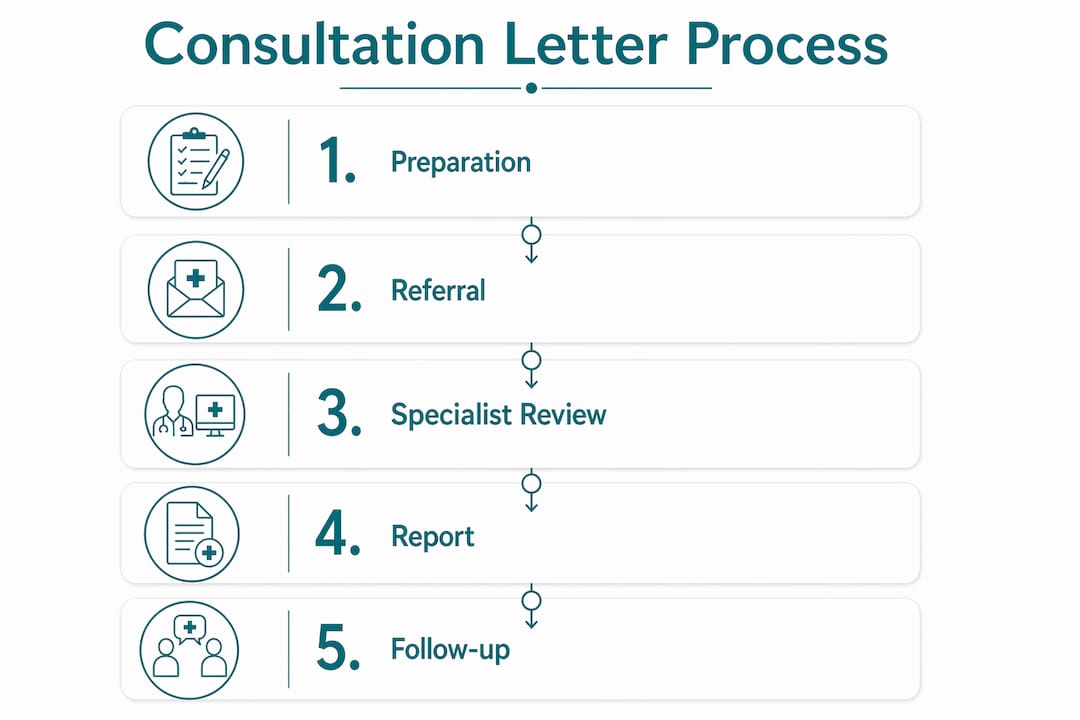
What are the most common pitfalls in consultation letters?
Up to 68% of referrals lack adequate clinical information. That number reflects a systemic problem, not individual carelessness. Busy primary care offices, time pressure, and no standardized template all contribute. Knowing the common failures helps you advocate for a better referral.
- Insufficient clinical detail. When the letter omits symptom duration, relevant history, or test results, the specialist spends your appointment gathering information instead of assessing you. This is the most common and most costly mistake.
2. A vague or missing consultation question. A clear consultation question is the most important sentence in a referral letter. Without it, the specialist writes a generic report that does not answer what your doctor actually needed to know.
3. Irrelevant medical detail. Overly long letters that include every diagnosis from the past 20 years bury the key information. Brevity and focus serve the specialist better than exhaustive history. A focused clinical summary outperforms a data dump every time.
4. Missing baseline workups. Patients referred without completed tests delay their own care. The specialist orders the same investigations your family doctor should have ordered first, adding weeks or months to your wait. Incomplete referrals contribute directly to longer specialist wait times across Canada.
5. No return communication plan. If the letter does not specify how the consultation report should be sent back, results can get lost between offices. Explicitly requesting the report's return method prevents this gap.
Pro Tip: Ask your family doctor whether your baseline bloodwork, imaging, or other relevant tests are attached to the referral before it is sent. Arriving at a specialist appointment without completed workup is one of the most common causes of a wasted visit.
How can you engage with your provider about your referral?
Patients often treat referrals as paperwork they have no say in. That is a missed opportunity. You are the one attending the appointment, and you have every right to understand what your referral says and why.
Start by asking your family doctor these questions before the referral is sent:
- Why are you referring me? Ask for a plain-language explanation of the reason, not just the specialist's name.
- What is the clinical question? You should know what your doctor is asking the specialist to assess or rule out.
- What tests are included? Confirm that all relevant results are attached so the specialist has what they need.
- How urgent is this? Understand whether your referral is marked routine, semi-urgent, or urgent, and what that means for your wait time.
- How will I receive the specialist's report? Know whether the report goes back to your family doctor and when you should expect a follow-up appointment.
Referral letters with thorough clinical detail are critical for care quality. Your engagement in that process makes a real difference. When you understand your referral, you can confirm that the specialist's office received it, follow up if your appointment is delayed, and arrive prepared.
Pro Tip: Request a copy of your referral letter for your own records. In Canada, you have the right to access your medical information. Having the letter helps you track your care and catch any errors before your appointment.
Mental health referrals carry additional complexity. If your referral involves psychiatric or psychological care, the differences in mental health referral processes in Canada are worth understanding before you engage with your provider.
Key Takeaways
A specialist consultation letter is the single most important document in your referral process. Its quality directly determines whether your specialist appointment is productive or wasted.
| Point | Details |
|---|---|
| Core function | The letter transfers clinical context and defines the specialist's task before your appointment. |
| Seven to eight components | Chief complaint, history, medications, allergies, test results, and a specific clinical question are all required. |
| Financial necessity | Many Canadian insurance plans require a formal referral letter before covering specialist visits. |
| Most common failure | Up to 68% of referrals lack adequate information, causing redundant tests and delayed care. |
| Patient's role | Ask your doctor to confirm the clinical question and attach all completed tests before the referral is sent. |
What I have learned from watching referrals succeed and fail
The referral letter is a professional handshake. That framing changed how I think about the entire process. When a family doctor sends a focused, well-organized letter with a clear clinical question, the specialist walks into the room already oriented. The appointment moves faster. The report is sharper. The patient gets an answer instead of another round of tests.
What I see more often, though, is the opposite. Vague letters. Missing workups. No consultation question. The specialist spends 20 minutes gathering information that should have arrived in the letter, and the patient leaves with a follow-up appointment instead of a diagnosis. That is not a specialist problem. It is a referral problem.
The part that surprises most patients is that they have real influence here. You can ask your doctor to read the consultation question out loud. You can confirm your bloodwork is attached. You can request a copy of the letter. These are not aggressive demands. They are reasonable questions that any good provider will welcome. The patients who engage with their referrals get better appointments. That pattern holds consistently.
> — Rishi
How Healthnavigatorai helps you understand your referral
Receiving a specialist referral can feel confusing, especially when the letter is written in clinical language you have never encountered before.
Healthnavigatorai gives Canadians a free, no-signup tool to make sense of their medical documents. You can upload your referral letter and receive a plain-English breakdown of what it says, what the specialist will likely assess, and what questions to bring to your appointment. You can also check your symptoms to understand whether a specialist referral may be appropriate for what you are experiencing. Healthnavigatorai does not sell or share your data, and no account is required. It is built specifically for Canadians who want to participate actively in their own care.
FAQ
What is the purpose of a specialist consultation letter?
A specialist consultation letter formally transfers clinical information from your primary care provider to a specialist, ensuring the specialist understands your condition and knows exactly what question to answer. Without it, specialist appointments are less focused and often less productive.
What should a consultation letter include?
A complete consultation letter includes the chief complaint, symptom duration, relevant medical history, current medications, allergies, recent test results, and a specific clinical question. A standardized format covering these seven to eight components reduces the risk of missing critical information.
Do I need a referral letter for specialist coverage in Canada?
Many Canadian insurance plans require a formal referral letter from a primary care provider before covering specialist visits. The requirement varies by province and plan, so confirming your coverage before your appointment is worth the effort.
Why do some referrals cause delays?
Up to 68% of referrals lack adequate clinical information, which forces specialists to order repeat tests or schedule additional appointments before they can assess you properly. Missing baseline workups are the most common cause of avoidable delays.
Can I ask to see my own referral letter?
Yes. Canadian patients have the right to access their medical records, including referral letters. Requesting a copy lets you verify the clinical question, confirm your test results are attached, and follow up if your appointment is delayed.


