

A telehealth assessment in Canada is a formal healthcare encounter conducted remotely via video, phone, or secure messaging to diagnose, monitor, or evaluate a patient's health without an in-person visit. The industry term for this practice is "virtual care," and Canada's national benchmark is the CAN/HSO 83001:2025 Virtual Care National Standard of Canada, which defines quality and safety requirements for remote clinical encounters. Telehealth services in Canada cover a wide range of clinical tasks, including diagnostic consultations, psychological evaluations, and remote monitoring. Understanding what a telehealth assessment involves, how it works, and when it applies to your situation is the first step toward using Canada's virtual care system confidently.
What is a telehealth assessment in Canada?
A telehealth assessment in Canada is any structured clinical evaluation delivered through telecommunication technology rather than a physical office. This includes video consultations, telephone appointments, and secure messaging platforms used by licensed healthcare providers. The assessment can cover diagnostic work, mental health screening, cognitive testing, or chronic disease monitoring, depending on the provider and the patient's needs.

The term "virtual care" is the recognized standard in Canadian healthcare policy. "Telehealth" and "telemedicine" are used interchangeably in everyday conversation, but all three terms describe the same core concept: a clinician evaluating a patient through technology rather than in person.
Telehealth assessments are not a workaround or a lesser option. Research shows that telepsychiatry diagnostic assessments achieve near-perfect concordance with face-to-face evaluations, with a Cohen's kappa of 0.824. That level of agreement means virtual psychiatric evaluations are clinically equivalent to in-person ones for most conditions.
How does telehealth assessment work in Canada?
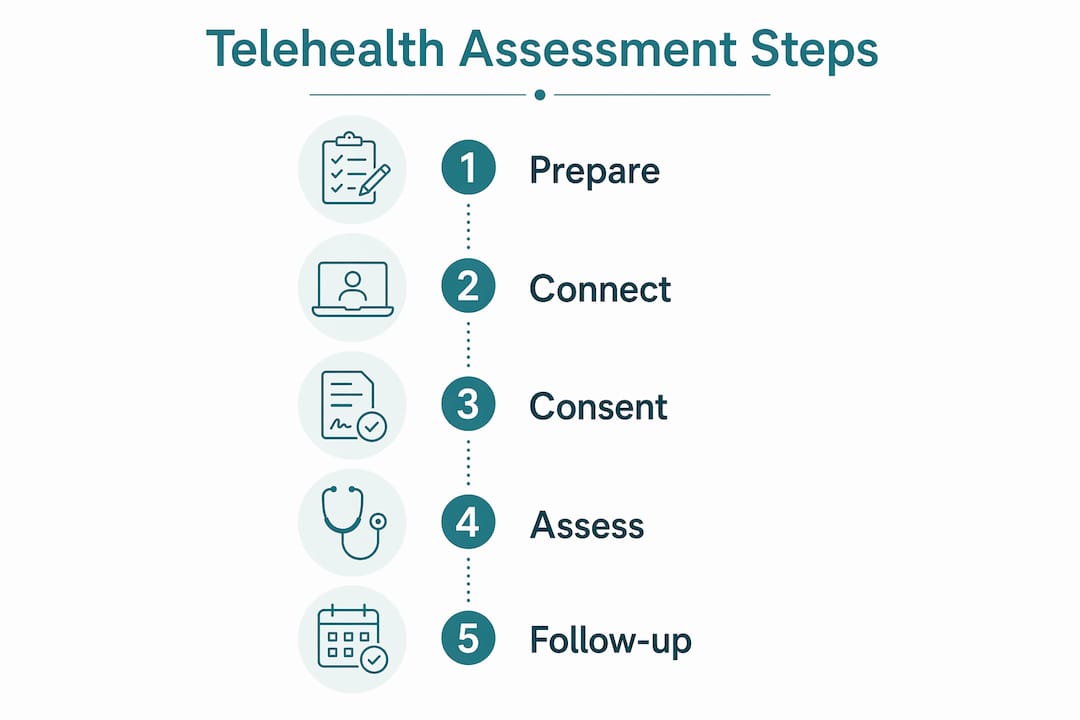
The telehealth consultation process follows a clear sequence. Most assessments use one of three primary modalities: live video conferencing, telephone calls, or asynchronous secure messaging. Video is the most common format for complex assessments because it allows the clinician to observe behavior, affect, and physical presentation in real time.
Before your appointment
Preparation matters more than most patients expect. You will typically need to:
- Confirm your device has a working camera and microphone.
- Test your internet connection in the room where you plan to meet.
- Find a private, quiet space where no one else can hear the conversation.
- Gather any relevant documents, medications, or prior test results.
- Complete any intake forms the provider sends in advance.
Pro Tip: Log into the video platform at least 10 minutes early. Technical delays at the start of an appointment cut into your assessment time, and clinicians may not be able to extend the session.
During and after the assessment
The clinician will confirm your identity, obtain digital consent, and verify that your environment is private. Privacy and digital readiness are formal requirements, not suggestions. A clinician can pause or cancel an assessment if privacy cannot be confirmed. For complex evaluations such as cognitive or autism assessments, a facilitator or caregiver may be present to manage technology and maintain a suitable testing environment. After the session, the provider sends a clinical summary, follow-up instructions, or referrals through a secure channel.
What are the benefits and limitations of telehealth assessments for Canadians?
Telehealth assessments deliver real, measurable advantages for Canadians, particularly those living in rural or remote regions. The benefits go beyond simple convenience.
Key benefits include:
- Reduced travel costs and time. Patients in northern communities can access specialists without flying or driving hundreds of kilometers.
- Faster access to care. Virtual appointments fill scheduling gaps that would otherwise mean weeks of waiting for an in-person slot.
- Access to specialists. Canadians in underserved areas can connect with psychiatrists, neuropsychologists, and developmental pediatricians who are not available locally.
- High diagnostic reliability. Autism assessments via telehealth show 94% diagnostic agreement with in-person evaluations across 182 cases, with an intraclass correlation coefficient of 0.85. That is a strong clinical result.
- Patient satisfaction. Families and patients consistently report improved satisfaction and efficiency compared to traveling for equivalent care.
> "Telehealth expands equitable access but does not fully resolve all barriers, particularly social and socioeconomic factors that limit digital access or literacy. The technology is only as useful as the patient's ability to use it confidently."
Limitations you should know
Not every patient or condition is suited to virtual care. Physical examinations requiring touch, such as palpation, auscultation, or neurological reflex testing, cannot be replicated remotely. Patients without reliable internet access or sufficient digital literacy face real barriers. Language and cultural factors also affect assessment quality, particularly for psychological evaluations that depend on nuanced communication. When a condition requires hands-on examination or when the patient cannot maintain a private, stable environment, an in-person assessment remains the right choice.
What regulations govern telehealth assessments in Canada?
Telehealth assessments in Canada operate under a layered set of professional, legal, and technical standards. Understanding these rules protects both you and your provider.
Licensing and jurisdiction
The Canadian Psychological Association's 2025 guidelines require clinicians to hold active licenses in both the province where the patient is located and the province where the provider practices. This jurisdictional rule applies to psychologists, physicians, and most regulated health professionals. A clinician licensed only in Ontario cannot legally assess a patient located in British Columbia without additional registration.
The CAN/HSO 83001:2025 standard
Canada's national virtual care standard sets requirements for quality, safety, cultural safety, and data security in telehealth encounters. It covers informed consent, documentation, and the technical specifications for secure communication platforms. Providers who follow this standard meet the baseline expectation for professional virtual care delivery.
Pro Tip: Before your first telehealth appointment, ask your provider which platform they use and whether it is compliant with Canadian privacy law. A reputable provider will answer this question without hesitation.
Privacy and digital consent
Canadian patients have the right to understand how their health data is collected and stored during a virtual encounter. Providers must obtain informed digital consent before the assessment begins. This consent covers the recording of sessions, data storage location, and third-party access. Patients also have the right to withdraw consent and request in-person care at any time.
| Regulatory area | Requirement |
|---|---|
| Clinician licensing | Licensed in both patient's and provider's province |
| National standard | CAN/HSO 83001:2025 Virtual Care Standard |
| Privacy law | Compliance with provincial health privacy legislation |
| Digital consent | Obtained before every assessment session |
| Cultural safety | Required under national virtual care standards |
Which conditions and patients are best suited for telehealth assessment?
Telehealth assessments work best for conditions where observation and conversation carry most of the diagnostic weight. Mental health evaluations, autism spectrum assessments, cognitive screenings, and chronic disease monitoring all show strong outcomes in virtual formats.
Conditions with high telehealth suitability
Telepsychiatry consistently produces reliable results for depression, anxiety, ADHD, and psychosis evaluations. Autism assessments in toddlers reach 94% diagnostic agreement with in-person evaluations. Cognitive assessments for older adults are feasible through facilitated or hybrid models, where an onsite support person assists with technology and test administration. Neuropsychological assessments are promising but still require condition-specific normative data developed for virtual delivery formats.
When in-person assessment is still necessary
Some clinical situations require physical presence. Complex neurological exams, assessments involving fine motor observation, and evaluations where the patient cannot maintain a private or stable environment all call for in-person care. Patients with significant cognitive impairment who cannot operate technology independently may also need an in-person setting, unless a trained facilitator is available.
| Patient or condition type | Telehealth suitability |
|---|---|
| Mental health evaluation | High |
| Autism spectrum assessment | High (94% diagnostic agreement) |
| Chronic disease monitoring | High |
| Cognitive screening with facilitator | Moderate to high |
| Complex physical examination | Low, in-person preferred |
| Neurological reflex testing | Low, in-person required |
Key Takeaways
Telehealth assessments in Canada deliver clinically reliable outcomes for most mental health, developmental, and monitoring conditions when patients meet basic technology and privacy requirements.
| Point | Details |
|---|---|
| Definition of virtual care | A telehealth assessment is a formal clinical encounter delivered via video, phone, or secure messaging. |
| Diagnostic reliability | Telepsychiatry reaches a Cohen's kappa of 0.824, confirming near-perfect agreement with in-person evaluations. |
| Regulatory requirements | Clinicians must hold licenses in both the patient's and provider's province under CAN/HSO 83001:2025. |
| Patient preparation | A private space, stable internet, and digital consent are required before every assessment. |
| Limitations | Physical examinations and complex neurological tests still require in-person visits. |
Why telehealth assessment in Canada is better than its reputation
I have followed virtual care adoption in Canada closely, and the most persistent misconception I encounter is that telehealth is a second-tier option. The evidence does not support that view. For psychiatric and developmental assessments, the diagnostic outcomes are comparable to in-person care. The gap between perception and reality is wide, and it costs patients real access to timely care.
What I find genuinely underappreciated is the role of the facilitator model. For older adults, children, or anyone with limited digital confidence, having a trained support person present during a virtual assessment changes the outcome entirely. Hybrid models, where a local support worker joins the session onsite while the specialist connects remotely, are already showing strong feasibility results. This is not a temporary workaround. It is a permanent feature of well-designed virtual care.
The equity challenge is real but solvable. Broadband access in rural and northern Canada remains uneven, and digital literacy gaps affect older and lower-income populations disproportionately. Clinician training in virtual assessment techniques also lags behind adoption rates. The technology is ready. The systems around it still need work.
My prediction is that telehealth assessments will become the default first contact for most non-emergency specialist referrals in Canada within the next five years. Patients who understand how the system works now will be better positioned to use it well.
> — Rishi
How Healthnavigatorai helps Canadians prepare for virtual care
Healthnavigatorai built MediGuide specifically for Canadians who need clear, fast guidance before or after a telehealth encounter.

MediGuide lets you describe your symptoms or upload a medical document to receive an immediate, plain-English assessment of your situation. The tool identifies which type of specialist you likely need, provides average wait times for your region, and requires no sign-up. Your data is never sold or shared. If you are preparing for a telehealth consultation and want to understand your symptoms before you speak with a clinician, check your symptoms now with MediGuide. It is free, private, and built for the way Canadians actually use healthcare.
FAQ
What is a telehealth assessment in Canada?
A telehealth assessment in Canada is a structured clinical evaluation conducted remotely through video, phone, or secure messaging by a licensed healthcare provider. It covers diagnostic, psychological, and monitoring tasks without requiring an in-person visit.
Is telehealth assessment as accurate as in-person care?
For most mental health and developmental conditions, yes. Telepsychiatry achieves a Cohen's kappa of 0.824 with in-person evaluations, and autism assessments via telehealth reach 94% diagnostic agreement.
Do I need special technology for a telehealth assessment?
You need a device with a working camera and microphone, a stable internet connection, and a private space. Less than 6% of patients report significant technical problems during telehealth assessments, so the barrier is lower than most people expect.
Are telehealth providers in Canada required to be licensed?
Yes. Canadian clinicians must hold active licenses in both the province where they practice and the province where the patient is located, as required under the Canadian Psychological Association's 2025 tele-assessment guidelines.
What health conditions are not suitable for telehealth assessment?
Conditions requiring hands-on physical examination, such as complex neurological testing or palpation, are not suited to virtual care. Patients without stable internet access or a private environment may also need to attend in person.


