

What is end-to-end encryption and why does it protect your health data?
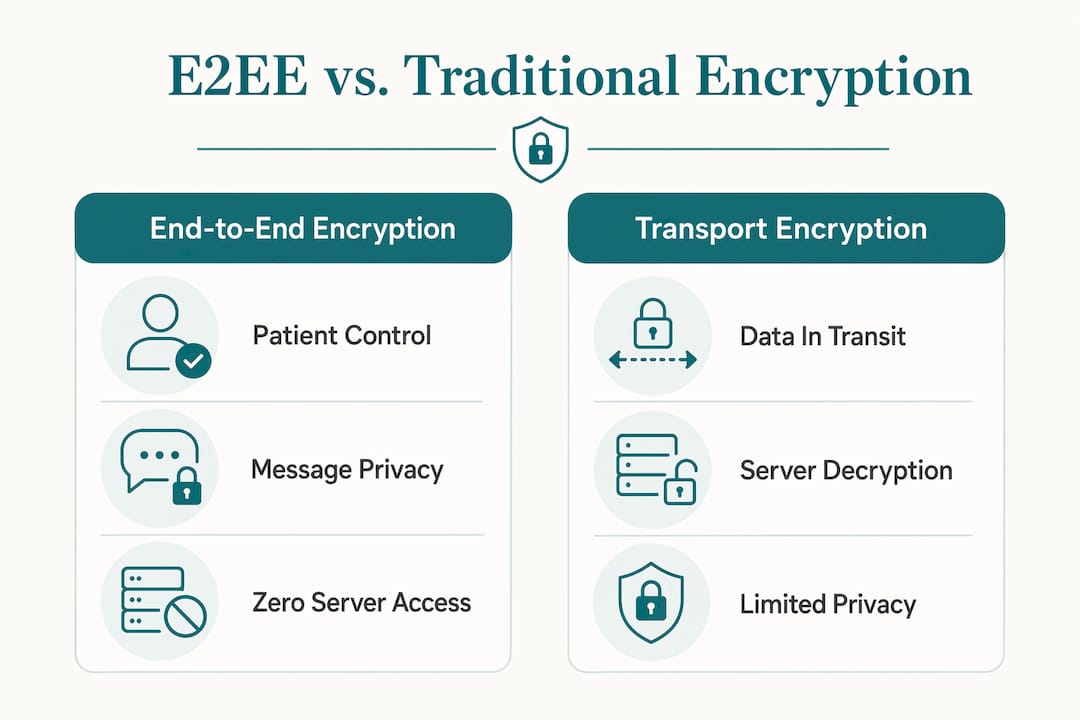
End-to-end encryption (E2EE) means your health data is locked on your device and can only be unlocked by the intended recipient. No server, no cloud provider, and no platform employee can read it in transit. That is a fundamentally different guarantee than what most health apps actually deliver.
Standard transport-layer encryption, like TLS or HTTPS, protects data while it travels to a server. Once it arrives, the server decrypts it. The platform can then read, store, or expose that content. As ClinicianCore explains, a platform that encrypts the delivery route but leaves the package readable at the destination has not achieved E2EE. It has achieved something weaker.
The stakes are real. The Anthem breach exposed a very large number of records in the US, illustrating what server-side access vulnerability looks like at scale. Lab results, clinical notes, mental health records, and prescription histories are all permanent. Unlike a credit card number, a leaked medical history cannot be reset.
Key reasons E2EE matters for health data:
- HIPAA compliance: The HIPAA Security Rule requires transmission security controls for electronic protected health information (ePHI), and E2EE directly satisfies that requirement.
- Minimum necessary principle: Platforms that decrypt content server-side create a structural vulnerability where vendor infrastructure becomes an unauthorized access point.
- Breach impact reduction: Stolen encrypted data is unreadable without keys, limiting legal exposure and reputational damage.
- Patient dignity: Medical records contain enough detail for identity fraud, discrimination, and serious personal harm if exposed.
Platforms like ClinicianCore, AccountableHQ, and Vidanis have built their compliance frameworks around E2EE as a structural guarantee, not a configurable option.
Why non-E2EE platforms put your health information at serious risk
The most dangerous phrase in healthcare technology is "HIPAA-compliant" attached to a platform that performs server-side decryption. Vendors can claim compliance while still holding the keys to your data. True E2EE removes vendor access entirely, which is the only architecture that genuinely supports the minimum necessary standard.
Zero-knowledge encryption takes this further. In a zero-knowledge system, only the patient holds the decryption key. The service provider stores the encrypted data but has no ability to open it, even under a subpoena or an insider threat. Standard encrypted systems let the company help you reset a forgotten password because they hold a copy of the key. Zero-knowledge systems cannot do that, which is both the strength and the practical challenge.
E2EE also has a known limitation: it protects message content but not metadata. Who messaged whom, when, and how often can still be visible to the service provider. In a behavioral health or addiction treatment context, those communication patterns alone can be sensitive.
Pro Tip: When evaluating any health platform, ask one direct question: "Can your staff read the content of messages sent through your system?" If the answer is yes, or if they cannot answer clearly, that platform is not using true E2EE. Minimum encryption standards to look for are AES-256 at rest and TLS 1.2 or higher in transit, as confirmed by a signed Business Associate Agreement and an independent SOC 2 Type II audit.
How E2EE creates real tension with healthcare AI and research
E2EE protects communications, but it complicates almost everything else a health system needs to do with data. Auditing, legal discovery, AI-assisted triage, and clinical research all require access to readable content. When keys live only on patient devices, server-side processing stops working.
Bradley A. Malin, a leading researcher in health data privacy at Vanderbilt University, has studied the privacy-utility trade-off extensively. His work, cited in Annual Reviews research on health data privacy, highlights that federated learning and secure multiparty computation are emerging as ways to run AI models on encrypted data without exposing the underlying records. These approaches let researchers extract patterns without ever seeing individual patient files.
The recordkeeping problem is also real. E2EE complicates integration with electronic health records because encrypted messages cannot be directly accessed for charting or legal discovery without client-side export workflows. Policies must be designed in advance to handle break-glass access, authorized key sharing, and secure archival.
> The core tension: Strong E2EE protects patients from breaches but can slow the AI tools and research pipelines that improve care. Neither extreme serves patients well. The answer is hybrid architectures where sensitive communications stay end-to-end encrypted while de-identified or aggregated data feeds research systems under strict governance.
Healthcare organizations that treat this as a binary choice, full E2EE or no E2EE, tend to make poor decisions in both directions. The HIPAA compliance checklist for long-term care approach, mapping each data workflow to the appropriate encryption model, is more practical than a blanket policy.
Practical steps Canadian patients can take to protect their health data
Canadian patients operate under PIPEDA and provincial privacy laws, but the technical risks are identical to those facing patients anywhere. The platform you use matters more than the jurisdiction you are in.
Steps worth taking now:
- Verify E2EE before sharing anything sensitive. Look for explicit confirmation that the platform cannot read your messages, not just that data is "encrypted."
- Use strong, unique passwords and enable two-factor authentication. A secure platform with a weak password is still vulnerable.
- Enable biometric login on any health app that offers it. If your device is stolen, biometrics add a layer that a password alone does not.
- Back up your recovery key securely. In zero-knowledge systems, losing your key means permanent lockout since no central reset exists.
- Avoid sharing lab results or clinical notes over standard email. Email travels across servers without E2EE protection, making it closer to a postcard than a sealed envelope.
- Check for security certifications. SOC 2 Type II reports and HITRUST CSF certification are the documentation standards that matter, not marketing claims.
Pro Tip: Use a password manager like 1Password or Bitwarden to store your recovery keys and health app credentials. Write the recovery key on paper and store it somewhere physically secure as a backup. This single step prevents the most common way patients lose access to zero-knowledge health accounts.
For guidance on Canadian health privacy protections and how to identify platforms that meet those standards, Healthnavigatorai's MediGuide resource covers the specifics of what Canadian patients should expect from any digital health tool.
How E2EE affects healthcare providers' ability to deliver care
E2EE creates genuine workflow friction for clinicians. When keys live on patient devices, providers cannot access message history from a different device, cannot run automated triage on message content, and face complications during care transitions when a patient is incapacitated. These are not hypothetical problems.

The practical answer is hybrid E2EE design. Platforms can keep sensitive communications end-to-end encrypted while routing non-sensitive operational data, scheduling, reminders, and metadata through standard encrypted channels that support server-side processing. This preserves confidentiality where it matters most without blocking the integrations that care teams depend on.
Device-level security remains the gap that E2EE cannot close. A clinician's unlocked phone, a shared workstation, or a compromised endpoint exposes data regardless of how strong the encryption is in transit. E2EE shifts the attack surface from the network to the endpoint, which means device management policies become as important as the encryption standard itself.
The future of encrypted health communication, from a privacy perspective
The direction of travel is clear. In December 2024, HHS published a Notice of Proposed Rulemaking to update the HIPAA Security Rule for the first time since 2013. The proposed changes would eliminate the "addressable" classification for encryption, making ePHI encryption at rest and in transit a mandatory standard rather than a risk-analysis option. That shift would effectively require what ClinicianCore, AccountableHQ, and Vidanis have already built into their platforms.
Zero-knowledge encryption and secure multiparty computation represent the next frontier. These approaches let health systems analyze data without ever decrypting it, resolving the privacy-utility tension that currently forces difficult trade-offs. The technology exists; the challenge is organizational adoption and the policy frameworks to govern it.
Transparency is the variable that patients can actually evaluate today. A privacy-first health platform publishes its encryption standards, provides a signed BAA, and answers the vendor-access question directly. Platforms that cannot do those three things are not ready for sensitive health data, regardless of what their marketing says.
Healthnavigatorai's MediGuide is built on exactly these principles: no sign-up required, no data sold or shared, and strict privacy protocols applied to every interaction. Patients who want to check their symptoms or upload a medical document can do so knowing their information stays private.
Key Takeaways
End-to-end encryption is the only architecture that prevents platform providers from accessing your health data, and it is becoming the regulatory baseline under proposed HIPAA updates.
| Point | Details |
|---|---|
| E2EE vs. transport encryption | TLS protects data in transit; E2EE ensures no server or vendor can read content at any point. |
| Zero-knowledge systems | Only the patient holds the decryption key, blocking access even under subpoenas or insider threats. |
| Metadata remains exposed | E2EE protects message content but not communication patterns, which can still reveal sensitive health behavior. |
| Device security is the weak link | E2EE cannot protect data on an unlocked or compromised device; biometrics and remote wipe are essential. |
| Regulatory direction | Proposed 2024 HIPAA updates would make ePHI encryption mandatory, not just addressable. |
A sharper look at what encryption actually promises
The encryption conversation in healthcare tends to get hijacked by compliance theater. A vendor checks the "encrypted" box, patients assume their data is safe, and the actual architecture, whether the vendor holds the keys or not, never gets examined.
What I find consistently underestimated is the metadata problem. Patients focus on whether their lab results are encrypted, which they should. But the pattern of who they message, when, and how often can be just as revealing. A patient messaging a psychiatric clinic three times a week tells a story even if the message content is perfectly encrypted. Platforms that take privacy seriously address metadata retention explicitly. Most do not.
The other thing worth saying plainly: zero-knowledge encryption is not always the right answer for healthcare. If you lose your recovery key and the platform genuinely cannot help you, you lose access to your own health history. That is a real cost. The right architecture depends on the clinical context, and patients deserve honest explanations of that trade-off rather than marketing language about "military-grade" protection.
The proposed HIPAA encryption mandate is a step forward, but standards only matter when they are enforced and when patients know enough to ask the right questions. The most important question remains the simplest one: can your platform staff read my messages? If a vendor hesitates on that answer, you have your answer.


