

Most consumer AI symptom-checkers and health-navigation tools are not covered by HIPAA. When you type symptoms into a chatbot or upload a medical PDF, you are the one transmitting that data to a third party, which typically removes it from HIPAA's legal umbrella and places it under the vendor's own privacy policy instead. The FTC and a growing set of state laws fill some of that gap, but enforcement is uneven. Your strongest immediate control is the deletion or opt-out request buried in account settings. The highest immediate risk is that privacy terms can change retroactively after you have already shared sensitive information. Healthnavigatorai is built around the opposite premise: no sign-up, no data sold, no records stored beyond the session.
Table of Contents
- What data do AI symptom-checkers actually collect from you?
- Does HIPAA protect what you share with an AI health tool?
- How vendors actually use your health data
- What technical safeguards actually protect your data?
- The real risks: re-identification, retroactive terms, and inference attacks
- Your checklist: how to evaluate a vendor before you share anything
- Before you share sensitive records: what to redact and when to hold back
- If your data is exposed: immediate steps and who to contact
- How long do vendors actually keep your data?
- How to read common privacy policy clauses in AI health contexts
- Symptom checkers vs. health navigation apps: how data handling differs
- Key Takeaways
- The privacy gap most users never think about
- What a privacy-first AI health tool looks like in practice
- Useful sources and further reading
What data do AI symptom-checkers actually collect from you?
These tools pull in more than just the symptoms you type. Understanding the full picture helps you decide what to share.
- Free-text symptom descriptions: The words you type or speak, including incidental personal details you may not realize you are including.
- Uploaded medical records: EHR exports, lab PDFs, prescription lists. Once uploaded, these sit on vendor servers.
- Device and sensor data: Steps, heart rate, sleep cycles from paired wearables or Apple Health.
- Metadata: Timestamps, IP addresses, session duration, browser fingerprint.
- Account and profile data: Age, sex, location, linked third-party accounts.
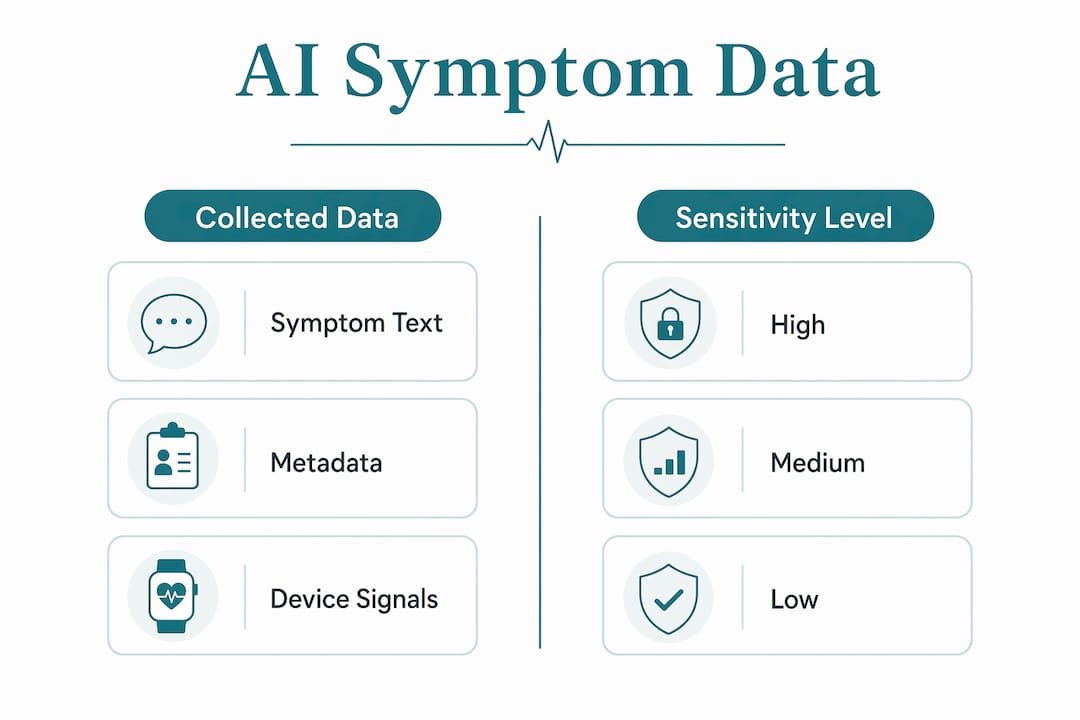
Metadata and device signals feel low-stakes, but they are not. A timestamp plus an IP address plus a symptom query can narrow your identity considerably, even without your name attached. Understanding how health app permissions work before you grant them is the first line of defense.
| Data Type | Examples | Sensitivity |
|---|---|---|
| Symptom text | "chest pain, shortness of breath" | High |
| Uploaded records | Lab results, EHR exports, prescriptions | High |
| Device/sensor data | Heart rate, steps, sleep | Medium–High |
| Metadata | IP address, timestamps, session logs | Medium |
| Account/profile | Age, sex, ZIP code | Medium |
Does HIPAA protect what you share with an AI health tool?
Usually not. Harvard Law School's analysis makes this plain: uploading protected health information to a consumer chatbot typically moves that data outside HIPAA's scope because the user, not a covered healthcare entity, initiates the transfer.
Who can actually see your data once it is in a vendor's system?
- The vendor's engineering and product teams
- Human reviewers or annotators (often for safety or quality feedback)
- Cloud infrastructure providers (AWS, Google Cloud, Azure) under their own terms
- Analytics and advertising vendors named in the privacy policy
- Government agencies under valid legal process
The FTC has authority over deceptive data practices when HIPAA does not apply, and states like Washington (My Health My Data Act) and Nevada have passed consumer health data laws that add a layer of protection. But these laws vary widely, and enforcement lags behind the pace of product releases.
How vendors actually use your health data
Vendors use your data for four main purposes: delivering the service, personalizing responses, monitoring for safety, and improving or training their models. The first two are expected. The third and fourth are where the details matter.

OpenAI's Health Privacy Notice states that medical records and health conversations imported through Health Features are not used to train foundational models by default. A limited number of authorized personnel may access that data for safety purposes unless you opt out. Google Health's FAQ takes a similar position: AI conversations are private by default, but human review can occur if you submit feedback, and research use requires a separate explicit opt-in.
What "not used for training by default" means in practice: your data may still be accessed for safety review, stored indefinitely, and shared with cloud processors. Opt-out does not equal deletion. Read the policy for the distinction.
Third-party cloud and analytics vendors routinely appear in vendor disclosures as processors. Their involvement affects where data is stored and which jurisdiction's laws apply to it.
What technical safeguards actually protect your data?
Encryption, differential privacy, and federated learning are the three most commonly cited protections. Each addresses a different threat.
- Encryption in transit and at rest: Scrambles data so it cannot be read during transfer or while stored. Standard practice, but it does not prevent the vendor from reading your data.
- Differential privacy (DP): Adds statistical noise to query outputs so individual records cannot be extracted from aggregate results. Protects model outputs, not raw uploaded files.
- Federated learning (FL): Trains models on data that stays on local devices or institutional servers rather than being centralized. A 2024 MDPI review confirms FL reduces raw-data transfer but still requires audits and verifiable implementation details to be trustworthy in production settings.
- Homomorphic encryption (HE): Allows computation on encrypted data without decrypting it first. Computationally expensive; rarely deployed at consumer scale yet.
- Secure multi-party computation (SMC): Lets multiple parties compute a joint result without revealing their individual inputs to each other.
Pro Tip: Differential privacy protects statistical outputs from a trained model. It does not make the raw files you uploaded private. If you upload a full medical record, DP offers you no protection for that document itself.
The real risks: re-identification, retroactive terms, and inference attacks
The highest-impact risks are re-identification and retroactive privacy changes. Both are underappreciated.
Research published in Nature shows that membership inference attacks (MIAs) can reveal whether a specific individual's data contributed to a training set. People from underrepresented groups face disproportionately higher re-identification risk because smaller training populations make individual records easier to isolate.
Key risks, ranked by likelihood of affecting you:
- Retroactive terms changes: A vendor updates its privacy policy after you have shared data. Your continued use typically constitutes consent.
- Re-identification: Supposedly de-identified health data can be linked back to you through auxiliary information.
- Human review exposure: Feedback submissions or safety flags can trigger a human reviewer reading your conversation.
- Data breaches: Centralized health data is a high-value target.
- Membership inference attacks: An adversary probes a model to determine if your record was in the training set.
Your checklist: how to evaluate a vendor before you share anything
Do these checks before you upload or paste health information into any AI tool.
- Read the privacy policy's data-use section first. Search for "train," "improve," and "third party." If those words appear without clear opt-out instructions, proceed cautiously.
- Find the opt-out toggle. Most serious vendors put it under Settings → Privacy or Data Controls. If you cannot find it in two minutes, assume opt-out does not exist.
- Check the retention period. Look for how long conversations are stored and whether deletion is permanent or just removes your view.
- Request data export before deletion. Use the privacy portal or email the data-request address (often listed as dsar@[vendor].com).
- Submit a deletion request in writing. Keep a copy of the request and any confirmation.
- Check third-party disclosures. The privacy policy should list cloud providers and analytics vendors. If it does not, that is a red flag.
Sample questions to send to vendor support or search for in the policy:
- "Do you use my health conversations to train or fine-tune models?"
- "Can I permanently delete all health conversations and uploaded records?"
- "Which third-party processors handle my health data, and where are their servers located?"
If a vendor does not respond or the policy is ambiguous, file a complaint with the FTC or your state attorney general. For guidance on asking health questions without sharing identifiers, see this practical guide.
Pro Tip: Transparency in a privacy policy is itself a signal. A vendor that lists every processor by name and links to their sub-processor agreements is operating at a different standard than one that says "trusted partners."
Before you share sensitive records: what to redact and when to hold back
Uploading a full medical record to a consumer AI tool is rarely necessary and often inadvisable. Extract only the pages relevant to your question.
- Redact name, date of birth, address, and insurance ID from any document before uploading.
- Avoid uploading psychiatric notes, genetic test results, or HIV/STI records unless the tool is operated by a covered healthcare entity with a signed BAA.
- Use anonymized symptom descriptions instead of pasting clinical notes. "I have had intermittent chest tightness for three weeks" conveys what the tool needs without your record attached.
- Never upload documents containing other people's information (a family member's records, for example).
Pro Tip: Clinicians share focused excerpts with specialists, not full charts. Apply the same discipline: give the AI only the slice of information it needs to answer your specific question.
For anonymous query approaches, anonymous health search options offers practical alternatives worth reviewing.
If your data is exposed: immediate steps and who to contact
Preserve evidence first, then act.
- Screenshot the vendor's privacy policy as it currently reads and save any confirmation emails.
- Change your account password and revoke any linked third-party app connections immediately.
- Submit a written deletion request to the vendor's privacy contact or data-request portal.
- File a complaint with the FTC at reportfraud.ftc.gov.
- Contact your state attorney general's consumer protection office.
- Enroll in an identity-monitoring service if the exposed data included Social Security numbers or financial identifiers.
Useful contacts:
- FTC: reportfraud.ftc.gov
- State AGs: naag.org/find-my-ag
- Electronic Frontier Foundation (EFF): eff.org — publishes guides on data rights and breach response
- Patient Privacy Rights: patientprivacyrights.org
Sample deletion request language: "I request permanent deletion of all personal data, health conversations, uploaded documents, and derived data associated with my account under [applicable state law / CCPA / My Health My Data Act]. Please confirm deletion in writing within 30 days."
How long do vendors actually keep your data?
Retention timelines vary widely and are rarely advertised prominently. Most consumer AI health tools retain conversation data for 30 days to several years depending on account type and jurisdiction. Some platforms delete data when you close your account; others retain de-identified or aggregated versions indefinitely for research.
What to look for in a retention clause: the difference between "we delete your account data" and "we delete all data derived from your account." Derived data, meaning model weights or aggregated statistics influenced by your inputs, may never be deleted even after your account is gone. That is a structural limitation of how large language models work, not a policy loophole a vendor can easily close.
How to read common privacy policy clauses in AI health contexts
Privacy policies use consistent patterns. Knowing what the language actually means saves time.
| Policy Clause | What It Usually Means |
|---|---|
| "We may use data to improve our services" | Your conversations can be used for model training unless you opt out |
| "De-identified data may be shared with partners" | Anonymized versions of your data go to third parties; re-identification risk remains |
| "Human review for safety and quality" | A person may read your conversation if it triggers a safety flag or you submit feedback |
| "We do not sell your personal data" | Direct sale is prohibited, but sharing with processors and analytics vendors is not selling |
| "You may request deletion via our privacy portal" | Deletion of your account data; derived or aggregated data may persist |
The phrase "trusted third-party service providers" almost always means cloud hosting, analytics, and customer-support vendors. Their names and data-processing agreements should be listed in a sub-processor disclosure. If they are not, ask.
Symptom checkers vs. health navigation apps: how data handling differs
Not all AI health tools handle data the same way. The differences matter before you choose one.
Symptom checkers (tools where you describe symptoms and receive a triage recommendation) typically collect only session-level data: the symptom text, a few demographic inputs, and metadata. Many operate without account creation, which limits persistent data collection. The trade-off is that without an account, you also have fewer controls: no deletion portal, no export, no conversation history to review.
Health navigation apps (tools that connect to EHRs, wearables, and insurance records to guide care decisions) collect far more. They aggregate clinical records, device streams, and behavioral data over time. That depth enables better personalization but creates a much larger data footprint. OpenAI's Health Features and Google Health Coach both fall into this category: they link to third-party medical providers, import records, and maintain persistent memory across sessions.
The practical rule: the more a tool personalizes over time, the more data it holds about you, and the more carefully you should read its retention and sharing terms.
Key Takeaways
Most consumer AI health tools operate outside HIPAA, leaving your data protected only by vendor policies and FTC enforcement, so reading the opt-out and deletion terms before you share anything is the single most protective step you can take.
| Point | Details |
|---|---|
| HIPAA usually does not apply | Consumer AI tools are typically not covered entities; vendor privacy policies govern your data. |
| Opt-out is not deletion | Turning off model training does not remove data already collected or derived from your inputs. |
| Re-identification is a real risk | De-identified data can be linked back to individuals, especially for underrepresented groups. |
| Read retention clauses carefully | Look for what happens to derived data after account deletion, not just account data. |
| Healthnavigatorai's approach | No sign-up required, no data sold, and sessions are not used to train models by default. |
The privacy gap most users never think about
The conversation about AI health privacy tends to focus on whether a tool is "HIPAA compliant." That framing misses the real question. HIPAA was designed for covered healthcare entities, not consumer software companies. The moment you type your symptoms into a chatbot that is not operated by your doctor's office or hospital, you have stepped outside that legal framework entirely.
What actually protects you is a combination of vendor policy quality, state law, and your own choices about what you share. The vendors with the clearest policies, the most granular opt-out controls, and the shortest retention windows are not necessarily the most famous ones. A tool that requires no account, collects no persistent data, and processes your query without storing it is structurally safer than one with a sophisticated privacy portal that still retains derived data indefinitely.
The conservative approach is not paranoia. It is the same logic a careful clinician applies: share the minimum necessary to get a useful answer, and verify who else can see it before you do.
What a privacy-first AI health tool looks like in practice
Healthnavigatorai takes a different approach to the trade-offs described above. No account creation means no persistent profile to breach. Symptom queries are processed without being stored for model training by default. Uploaded documents are handled through a secure upload flow designed to minimize retention, and users can check symptoms without linking insurance records or wearable data.
That architecture is not accidental. Minimizing data collection at the point of intake is the most reliable privacy protection available, because data that is never stored cannot be breached, re-identified, or subject to a retroactive terms change. For users who want to understand the full philosophy behind this approach, the why Healthnavigatorai page explains the privacy-first design choices in plain language. Start with a symptom check and see how a no-sign-up, no-storage model changes the experience.
This article is general information, not medical or legal advice. Verify current rules with the relevant regulatory body or a qualified professional for your specific situation.
Useful sources and further reading
- Harvard Law School: Does HIPAA protect what you tell ChatGPT? — Explains why consumer AI interactions typically fall outside HIPAA and what legal framework applies instead.
- Nature: Disparate privacy risks from medical AI — Peer-reviewed audit showing membership inference attacks succeed at patient-level resolution and affect underrepresented groups disproportionately.
- MDPI: Balancing Privacy and Progress in AI-Driven Healthcare — 2024 review of federated learning, differential privacy, and homomorphic encryption as practical safeguards.
- OpenAI Health Privacy Notice — Primary source for how ChatGPT Health handles imported medical records and opt-out controls.
- Google Health Privacy FAQ — Explains human-review triggers, research opt-in, and data deletion for Google Health Coach users.
- Harvard T.H. Chan School of Public Health: AI and your health care data — Panel discussion on AI's impact on health data privacy and protection across clinical and consumer contexts.
- Healthnavigatorai: De-identified health information — Plain-language explanation of de-identification limits and re-identification risk.
- Healthnavigatorai: What is a privacy-first health platform? — Covers the design signals users should look for when evaluating a vendor's privacy claims.
- SOS-ID Privacy Policy — Example of a third-party processor privacy disclosure; useful reference when reviewing sub-processor agreements in vendor policies.


