

Medical prefixes and suffixes are word parts that attach to a root word to specify a condition, location, or procedure in medical terminology. Understanding how medical prefixes and suffixes work is the fastest path to decoding the complex language doctors use every day. A term like pericarditis looks intimidating until you recognize three distinct parts, each carrying its own meaning. This guide breaks down the structure of medical word formation, explains the rules that govern spelling, and gives you a practical method to decode any term you encounter.
How do medical prefixes and suffixes work?
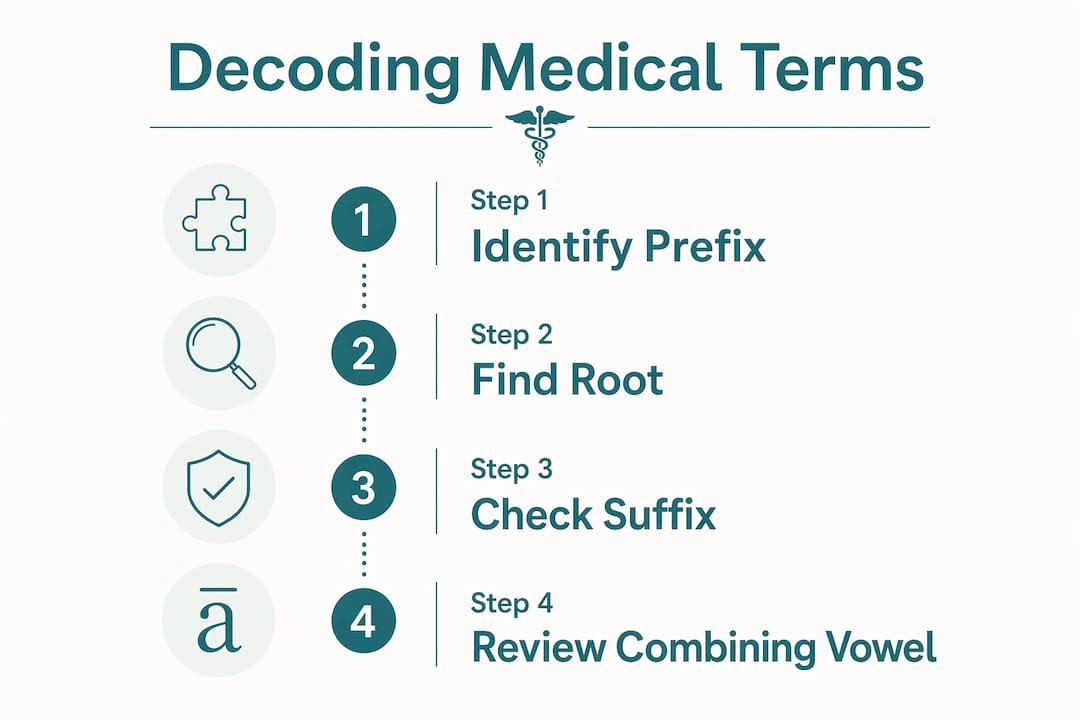
Medical terms are built from up to four components: an optional prefix, a root word, a suffix, and a combining vowel. The prefix modifies meaning/01%3A_Basic_Word_Structure/1.01%3A_Basic_Word_Structure) at the start of a term, while the suffix defines the term's category at the end. The root carries the core concept, and the combining vowel connects parts without adding meaning. Together, these components let clinicians build thousands of precise terms from a limited set of parts.
Think of it as a code. Once you know the parts, you can read terms you have never seen before. A patient who understands that intra means "within" and venous refers to veins can immediately grasp what an intravenous line does. That kind of literacy reduces confusion and helps people ask better questions during medical appointments.

What are common medical prefixes, and how do they change meaning?
A prefix is placed at the beginning of a medical term and changes the meaning of the root that follows it. Prefixes never carry a combining vowel after them. They attach directly to the root or combining form. Recognizing a prefix tells you the context of a term before you even reach its core meaning.
Common prefixes and their meanings include:
- peri (surrounding): pericardium = structure surrounding the heart
- intra (within): intravenous = within a vein
- dys (painful, difficult, abnormal): dyspnea = difficult breathing
- brady (slow): bradycardia = slow heart rate
- hyper (above, excessive): hypertension = excessive blood pressure
- hypo (below, deficient): hypoglycemia = low blood sugar
- sub (under, below): subcutaneous = under the skin
Each prefix actively constrains what the term can mean. Peri does not just add flavor to cardium. It specifies that the structure wraps around the heart, not inside it. That distinction matters clinically. The prefix peri combined/01%3A_Basic_Word_Structure/1.01%3A_Basic_Word_Structure) with cardi and um produces pericardium, a term that precisely names the sac surrounding the heart.
Pro Tip: When you encounter an unfamiliar term, read the prefix first. It immediately narrows the meaning to a location, quantity, or status before you decode the rest.
How do suffixes in medical terms specify conditions and procedures?
A suffix always appears at the end of a medical term and defines what category the term belongs to. Suffixes commonly indicate/02%3A_Suffixes/2.03%3A_Additional_Suffixes) a condition, a process, a procedure, or a specialty. Identifying the suffix first gives you the broadest frame for understanding a term before you fill in the specifics.
Key suffixes and their meanings include:
- itis (inflammation): gastritis = inflammation of the stomach
- logy (study of): cardiology = study of the heart
- logist (specialist in): cardiologist = specialist in heart conditions
- ectomy (surgical removal): appendectomy = surgical removal of the appendix
- plasty (surgical repair): rhinoplasty = surgical repair of the nose
- ium (structure): pericardium = structure surrounding the heart
- osis (condition, process): fibrosis = condition of fibrous tissue formation
- algia (pain): neuralgia = nerve pain
Suffix spelling variations carry real meaning differences. The suffix families with close spelling/02%3A_Suffixes/2.03%3A_Additional_Suffixes) differences, such as logy versus logist, point to entirely different roles. Cardiology names the field. Cardiologist names the person who practices it. Confusing the two in a clinical note or a patient record creates real errors.
Pro Tip: Start decoding any medical term from the suffix. It tells you whether you are dealing with a disease, a procedure, a specialty, or a body structure before you read anything else.
How do combining vowels connect word parts?
A combining vowel is a single vowel, usually o and occasionally i, that connects a root to a suffix or joins two roots together. Combining vowels are connectors/01%3A_Basic_Word_Structure/1.02%3A_Medical_Language_Rules) that ease pronunciation. They carry no meaning on their own. Separating this spelling mechanic from actual word meaning accelerates learning because you stop second-guessing why the vowel is there.
Two rules govern when to keep or drop the combining vowel:
- Keep the combining vowel when the suffix begins with a consonant. Example: ven/o + ous = venous (the o stays because ous starts with a vowel... wait, see the table below for the clearer rule).
- Drop the combining vowel when the suffix begins with a vowel. Example: gastr/o + itis = gastritis, not gastroitis.
The table below shows the rule applied to real terms:
| Combining form | Suffix | Suffix starts with | Result | Vowel kept or dropped |
|---|---|---|---|---|
| gastr/o (stomach) | itis (inflammation) | vowel | gastritis | dropped |
| cardi/o (heart) | logy (study of) | consonant | cardiology | kept |
| ven/o (vein) | ous (pertaining to) | vowel | venous | dropped |
| oste/o (bone) | arthr/o + itis | consonant (joining two roots) | osteoarthritis | kept |
The combining vowel rule/01%3A_Basic_Word_Structure/1.02%3A_Medical_Language_Rules) explains why gastritis and cardiology are spelled differently despite both using the root with an o combining form. Once you internalize this single rule, dozens of spelling patterns click into place.
How to decode medical terms step by step
The most reliable method for decoding medical terms starts with the suffix and works left. Breaking the word into parts/01%3A_Basic_Word_Structure/1.06%3A_Identifying_Word_Parts_in_Medical_Terms) using slashes gives you a visual map before you interpret anything. This mirrors how clinicians categorize conditions, which is why it builds comprehension faster than memorizing whole terms.
Follow these steps for any unfamiliar term:
- Write the term and place slashes between each part. Example: peri / cardi / um
- Read the suffix first. um = structure. You now know this term names a body structure.
- Read the prefix next. peri = surrounding. The structure surrounds something.
- Read the root. cardi = heart. The structure surrounds the heart.
- Add filler words to build a plain sentence: "a structure that surrounds the heart." That is pericardium.
Adding filler words to connect the parts into plain language aids patient understanding/01%3A_Basic_Word_Structure/1.02%3A_Medical_Language_Rules) without changing the clinical meaning. The method works across term types:
| Medical term | Parts | Plain meaning |
|---|---|---|
| intravenous | intra (within) + ven (vein) + ous (pertaining to) | pertaining to within a vein |
| osteoarthritis | oste/o (bone) + arthr (joint) + itis (inflammation) | inflammation of the bone and joint |
| pericardium | peri (surrounding) + cardi (heart) + um (structure) | structure surrounding the heart |
| dyspnea | dys (difficult) + pnea (breathing) | difficult breathing |
One important nuance: not all medical terms have prefixes/01%3A_Basic_Word_Structure/1.06%3A_Identifying_Word_Parts_in_Medical_Terms), and occasionally the root is embedded inside the suffix. Do not force all four components onto every term. Gastritis has no prefix. Cardiology has no prefix. The decoding method still works. You simply skip the prefix step when it is absent.
Key Takeaways
Medical prefixes and suffixes are active meaning modifiers that, combined with roots and combining vowels, let you decode thousands of terms from a small set of parts.
| Point | Details |
|---|---|
| Prefixes set context | A prefix placed before the root specifies location, quantity, or status immediately. |
| Suffixes define category | Reading the suffix first tells you whether a term names a disease, procedure, or specialty. |
| Combining vowels are connectors | Drop the combining vowel before a suffix starting with a vowel; keep it before a consonant. |
| Decode suffix first | Starting with the suffix mirrors clinical categorization and speeds up comprehension. |
| Not all terms have all parts | Some terms lack a prefix; others embed the root inside the suffix. Always check before assuming. |
Why I think most people learn medical terms the wrong way
Most people try to memorize medical terms as whole words. That approach fails fast. The vocabulary is too large, and the terms change constantly as new procedures and conditions get named. What actually works is treating prefixes and suffixes as active modifiers rather than decorative syllables.
The shift in mindset matters more than the flashcard count. When you see dys at the start of a term, you immediately know something is abnormal or difficult. When you see itis at the end, you know inflammation is involved. Those two pieces of information narrow a 20-letter term down to something you can reason through in seconds. That is not memorization. That is literacy.
The decoding strategy, starting from the suffix and working left, mirrors how clinicians actually think about conditions. A cardiologist does not hear pericarditis and process it as one unit. They process it as inflammation (itis) of the tissue surrounding (peri) the heart (cardi). You can do the same thing after one afternoon of focused practice.
The practical benefit shows up most clearly when you are reading a medical assessment or a discharge summary and you hit a term you have never seen. Instead of panic, you have a process. That process is the real payoff of learning prefixes and suffixes, not the ability to impress anyone with vocabulary.
> — Rishi
Healthnavigatorai makes medical language less confusing
Medical documents are full of terms that stop people cold. Healthnavigatorai is a free, no-sign-up tool built for Canadians who want plain-English guidance when they encounter confusing health information.

You can check your symptoms and get a clear assessment of what they might mean, including which specialist to see and average wait times in your region. You can also upload a medical document and receive a plain-English breakdown of the terminology inside it. Healthnavigatorai does not store or share your data. No login is required. It is built for the moment you are staring at a medical report and need a clear answer fast.
FAQ
What is a medical prefix?
A medical prefix is a word part placed at the beginning of a medical term that modifies the meaning of the root. Examples include peri (surrounding), intra (within), and dys (abnormal or difficult).
What is a medical suffix?
A medical suffix is a word part placed at the end of a medical term that defines its category, such as a condition, procedure, or specialty. Common examples are itis (inflammation), logy (study of), and ectomy (surgical removal).
What is a combining vowel in medical terminology?
A combining vowel, usually o or occasionally i, connects a root to a suffix or joins two roots. It is dropped when the following suffix begins with a vowel and kept when the suffix begins with a consonant.
How do you decode an unfamiliar medical term?
Place slashes between word parts, read the suffix first to identify the category, then read the prefix and root from left to right. Adding plain filler words between the parts produces a readable definition without changing the clinical meaning.
Do all medical terms have a prefix?
No. Many medical terms have no prefix at all. Gastritis and cardiology are both complete terms without a prefix. Some terms also embed the root inside the suffix, so not every term follows the full four-part structure.


