

Doctors use Latin terminology because it provides a single, precise language that works identically for a surgeon in Toronto, a physician in Tokyo, and a pharmacist in Berlin. Medical Latin, the formal system of anatomical and clinical nomenclature built on Latin and Greek roots, is not an accident of history. It is a deliberate, maintained standard that prevents dangerous ambiguity in diagnosis, documentation, and treatment. Understanding why doctors use Latin terminology reveals how a 500-year-old linguistic tradition still protects patients every day.
Why doctors use Latin terminology in medicine
Latin became the default language of medicine because it was already the default language of European scholarship. When Renaissance anatomists began systematically mapping the human body in the 15th and 16th centuries, they wrote in Latin because every educated physician across Europe could read it. The Flemish anatomist Andreas Vesalius published De humani corporis fabrica in 1543, establishing Latin anatomical vocabulary that physicians still use today. Terms like os temporale (temporal bone) and musculus biceps brachii (biceps muscle of the arm) trace directly to that era.
European universities then locked this vocabulary into their curricula. Medical students from London to Krakow learned the same Latin terms, creating a shared professional language that crossed national borders without translation. Latin terminology was institutionalized through Renaissance anatomy and European scholarship, and it has been embedded in medical education continuously ever since.
Latin also absorbed Greek. Ancient Greek physicians, including Hippocrates and Galen, had already named many diseases and procedures. When Latin-speaking scholars translated and systematized this knowledge, Greek terms for pathology and surgery were folded into the Latin framework. The result is a hybrid system where both languages contribute distinct roles, which Section 5 covers in detail.
Pro Tip: If you encounter an unfamiliar medical term, look for the Latin or Greek root first. "Cardio" comes from the Greek kardia (heart), and "pulmonary" from the Latin pulmo (lung). Recognizing these roots immediately narrows down what any term refers to.
Here is a quick overview of how Latin entered medicine through key historical channels:
- Renaissance anatomy (1400s to 1600s): Vesalius and contemporaries published dissection atlases in Latin, standardizing body-part names across Europe.
- University curricula (1500s onward): Medical schools required Latin literacy, cementing its role as the professional language of medicine.
- Pharmacopoeia tradition: Early drug catalogs, called pharmacopoeias, were written in Latin to allow cross-border use by apothecaries and physicians.
- Church and scholarly networks: The Catholic Church's use of Latin as an administrative language reinforced its status as the language of educated professionals, including doctors.
How Latin creates precision and universal understanding
Latin is foundational in anatomy, clinical terminology, and pharmacology, supporting precision and intercultural understanding across every medical specialty. This is not a nostalgic preference. It is a functional requirement.

Consider what happens without a standardized system. The kidney has different names in French (rein), German (Niere), Spanish (riñón), and Mandarin. If an international team of surgeons relies on vernacular terms, miscommunication becomes a real risk. Latin eliminates that risk. Every physician worldwide recognizes ren as the kidney, regardless of their native language.
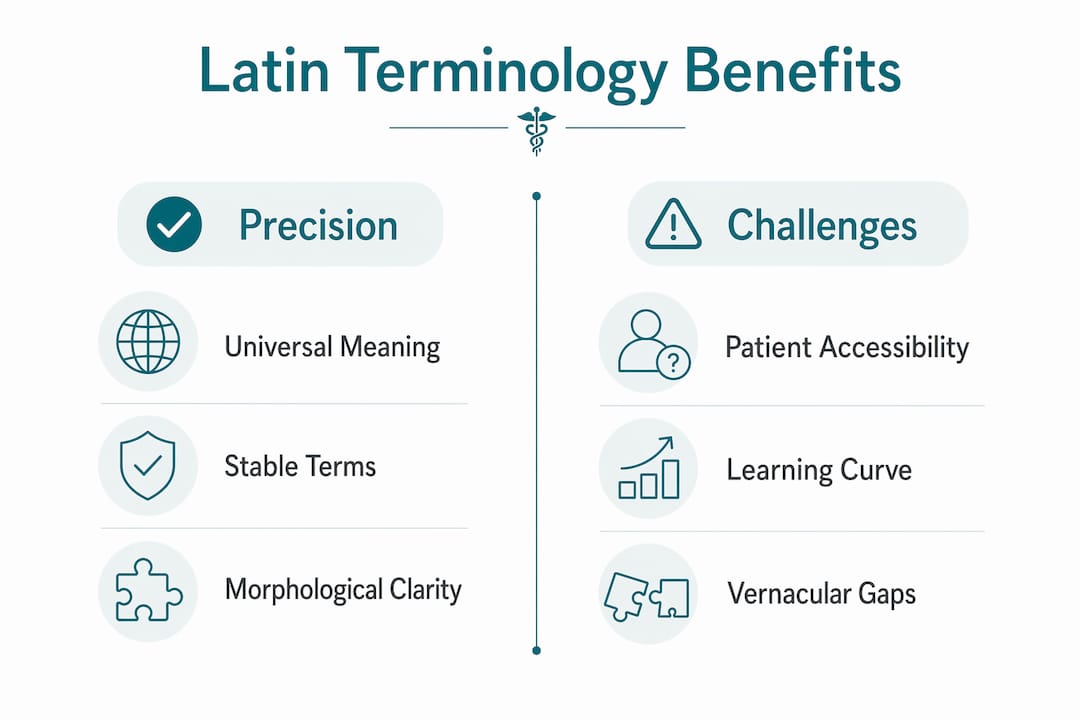
The governing body for anatomical naming, the Federative International Programme on Anatomical Terminology, publishes Terminologia Anatomica, the official international standard for human anatomical terms. Terminologia Anatomica updates reflect Latin's ongoing role in unifying anatomical terminology across more than 80,000 named structures in the human body. That scale of standardization is only possible because Latin provides a neutral, stable base that no single nation owns.
The table below illustrates how Latin terms function as universal anchors compared to their vernacular equivalents:
| Latin term | English equivalent | Why Latin is preferred |
|---|---|---|
| *Musculus trapezius* | Trapezius muscle | Identical in all medical literature worldwide |
| *Arteria carotis communis* | Common carotid artery | Prevents confusion with regional naming variants |
| *Os sacrum* | Sacrum (tailbone area) | Precise anatomical location encoded in the name |
| *Nervus vagus* | Vagus nerve | Consistent across neurology, cardiology, and surgery |
Pro Tip: When reading a medical report, Latin terms are your most reliable anchors. They mean exactly the same thing in every country's medical system, so looking up the Latin term gives you the most accurate definition.
Latin anatomical terms act as stable identifiers unaffected by local language changes, which is exactly why clinical documentation systems, electronic health records, and international research papers continue to use them. Replacing Latin with English, for example, would immediately create a two-tier system where English-speaking countries held a structural advantage. Latin's neutrality is part of its value.
How Latin roots make medical terms decipherable
Medical terminology Latin is not a list of words to memorize. It is a construction system. Learning root combinations helps students understand unfamiliar terms accurately, which means a clinician who knows the building blocks can decode a term they have never seen before.
Take the word nasopharyngolaryngoscope. It looks impenetrable until you break it into parts: naso (nose) + pharyngo (throat) + laryngo (voice box) + scope (instrument for viewing). The word literally describes a device that views the nose, throat, and voice box. No memorization required. The structure tells you everything.
Latin roots are part of a constructed system that offers precise and specific medical terms, not arbitrary labels. This is why Dalhousie University introduced a dedicated course on ancient languages in medical education, teaching students to decode terminology through morphology rather than rote memorization. The approach pays off across every specialty because the same roots appear repeatedly.
The core building blocks work like this:
- Prefixes modify meaning. Hyper (above normal), hypo (below normal), brady (slow), tachy (fast). A patient with hypertension has above-normal blood pressure. A patient with bradycardia has a slow heart rate.
- Roots identify the body part or condition. Hepat (liver), nephro (kidney), derm (skin), osteo (bone). Hepatitis is inflammation of the liver. Osteosarcoma is a bone cancer.
- Suffixes describe what is happening. itis (inflammation), ectomy (surgical removal), ology (study of), algia (pain). Appendectomy is the removal of the appendix. Neuralgia is nerve pain.
Teaching morphology over memorization helps medical students understand and apply terminology effectively across specialties. A student who memorizes 2,000 terms knows 2,000 terms. A student who learns 200 roots, prefixes, and suffixes can decode tens of thousands of terms. The math strongly favors the morphological approach.
This system also reduces errors. When a term is constructed logically, a clinician who misremembers it can often reconstruct the correct version from the parts. Rote memorization offers no such safety net.
Latin vs. Greek vs. plain English in medical language
Latin and Greek are not interchangeable in medicine. Latin anatomical adjectives coexist with Greek disease and procedure names, each fulfilling distinct linguistic roles. Understanding the division clarifies why both languages remain in use.
The kidney example makes this concrete. The anatomical adjective for the kidney is renal, from the Latin ren. Doctors say "renal artery" and "renal cortex" when describing anatomy. But the disease name nephritis (kidney inflammation) comes from the Greek nephros. Both terms refer to the same organ, but they serve different functions in clinical language. Latin handles anatomy; Greek handles pathology and procedures.
| Context | Language origin | Example | Meaning |
|---|---|---|---|
| Anatomical structure | Latin | *Arteria renalis* | Renal artery |
| Disease name | Greek | *Nephritis* | Kidney inflammation |
| Surgical procedure | Greek | *Nephrectomy* | Kidney removal |
| Specialty name | Greek | *Nephrology* | Study of kidney disease |
The modern debate centers on patient communication. Critics argue that Latin and Greek terms exclude patients from understanding their own diagnoses. A patient told they have myocardial infarction may not realize this means a heart attack. This criticism is valid for patient-facing communication, and many healthcare systems now require plain-language summaries alongside formal diagnoses.
However, switching from Latin to vernacular would risk consistency and interoperability in education and clinical documentation. The solution most medical systems have adopted is bilingual documentation: Latin or Greek terms in clinical records and research, plain English in patient-facing materials. This preserves the precision of the formal system while improving patient understanding.
Key takeaways
Latin in medical language works because it provides a stable, neutral, and morphologically logical system that no vernacular language can replicate at global scale.
| Point | Details |
|---|---|
| Universal communication | Latin terms mean the same thing in every country, eliminating translation errors in clinical settings. |
| Historical continuity | Vesalius and Renaissance anatomists established Latin vocabulary still used in anatomy today. |
| Morphological decoding | Knowing prefixes, roots, and suffixes lets clinicians decode unfamiliar terms without memorization. |
| Latin vs. Greek roles | Latin handles anatomical adjectives; Greek handles disease names and surgical procedures. |
| Plain language balance | Clinical records use Latin for precision; patient materials use plain English for accessibility. |
Why I think Latin's role in medicine is more logical than it looks
People often assume Latin in medicine is a gatekeeping mechanism, a way for doctors to sound authoritative or keep patients in the dark. I understand why that impression exists. But after spending years reading medical literature and working with health communication, I am convinced the opposite is true.
Latin is the least political option available. If medicine standardized on English, French, or Mandarin, every non-native speaker of that language would be at a structural disadvantage. Latin belongs to no living nation. It carries no geopolitical weight. A physician in Nigeria and a physician in Norway start from the same neutral ground when they both learn musculus sternocleidomastoideus.
The morphological argument is also underappreciated. Morphology encodes meaning and reduces ambiguity compared to memorization. This is not a minor pedagogical preference. It is the difference between a system that scales and one that breaks under the weight of new discoveries. Every new disease, procedure, or drug can be named using existing Latin and Greek roots, and any trained clinician can immediately parse the meaning.
My advice to anyone learning medical terminology: stop treating Latin roots as obstacles and start treating them as a cipher. Once you hold the key, the entire vocabulary opens up. Healthnavigatorai was built on exactly this principle. Making medical language accessible does not require abandoning precision. It requires translation, not replacement.
> — Rishi
Understanding your medical documents just got easier
Medical jargon can make even a routine lab report feel like a foreign language. Healthnavigatorai offers a free, no-signup AI tool that translates complex medical terms and documents into plain English, helping Canadians understand exactly what their doctors are telling them.

Whether you have received a report filled with Latin anatomical terms or a prescription you cannot parse, you can upload your medical document directly to MediGuide for an immediate, plain-language explanation. The tool also connects you to the right specialists and provides regional wait time estimates, so understanding your diagnosis is just the first step toward acting on it. No data is sold or shared. No account required.
FAQ
Why do doctors still use Latin if no one speaks it?
Latin remains essential as a universal linguistic system in international medical communication precisely because no one speaks it natively. Its neutrality prevents any single language from dominating global medical standards.
What is the difference between Latin and Greek in medical terms?
Latin primarily provides anatomical adjectives, such as renal for kidney-related structures, while Greek supplies disease names and procedure terms, such as nephritis for kidney inflammation. Both systems operate simultaneously in clinical language.
Can learning Latin roots help me understand my own medical records?
Yes. Latin roots are part of a constructed system built on prefixes, roots, and suffixes, so recognizing components like hepat (liver) or itis (inflammation) lets you decode terms you have never seen before.
Why don't doctors just use plain English instead?
Plain English works well for patient communication, but replacing Latin in clinical documentation would break international consistency. A term like arteria renalis is identical in medical records from Canada, Germany, and South Korea. An English equivalent would require translation for most of the world's physicians.
Is Latin terminology the same worldwide?
Yes. Terminologia Anatomica, the international standard maintained by the Federative International Programme on Anatomical Terminology, uses Latin to define over 80,000 anatomical structures with consistent names recognized by medical professionals globally.


