

"Within normal limits" is a medical lab term indicating that a test result falls within the central 95% range observed in apparently healthy people. That phrase on your lab report does not mean your health is perfect. It means your value sits inside a statistical boundary, not that you are free of symptoms or disease. Understanding why test results say within normal limits, and what that label actually tells you, is one of the most useful things you can do as a patient reviewing your own results.
Why test results say "within normal limits": the statistical foundation
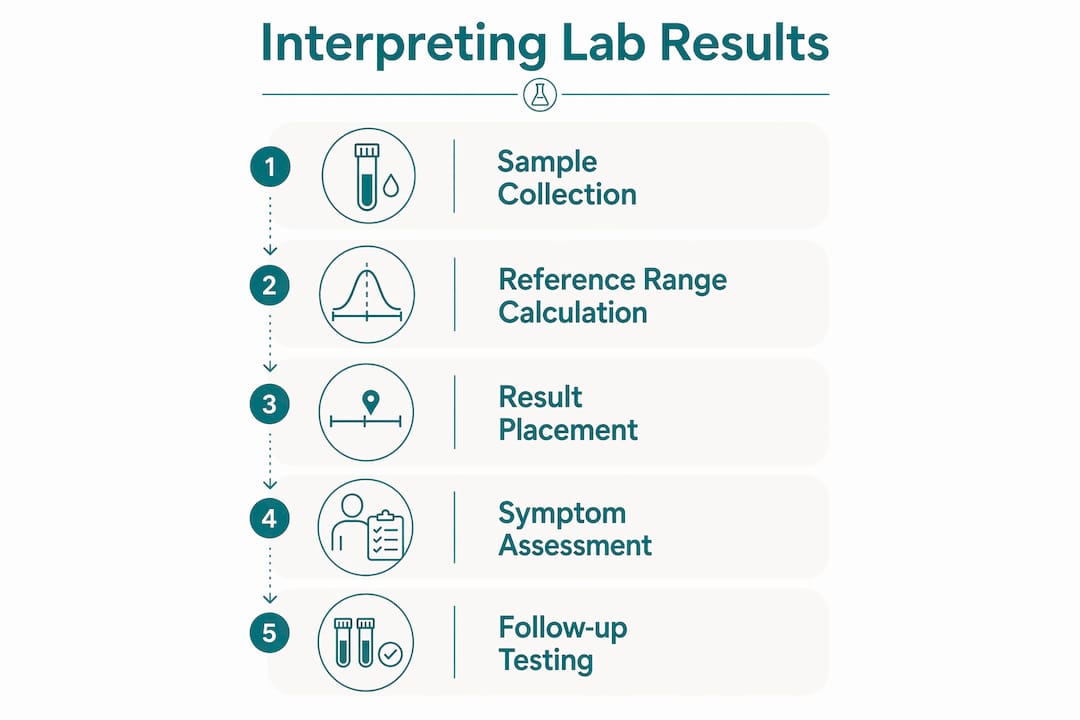
Labs define "within normal limits" by testing at least 120 healthy individuals and calculating the central 95% of their values. The bottom 2.5% and the top 2.5% are excluded, creating the reference range. That means 5% of healthy people fall outside the normal range on any given test, even though nothing is wrong with them. A flagged result does not always signal disease. A clean result does not always signal health.
The technical term for this boundary is a "reference interval," and clinical labs use two main methods to calculate it. Some labs use parametric calculations, which assume values follow a bell curve. Others use non-parametric calculations, which rank values by percentile without assuming a specific distribution. Both methods are valid, but they can produce slightly different limits for the same test.

Reference ranges also shift based on the population used to build them. A lab in one region may draw its reference population from a different demographic than a lab across the country. Equipment and reagents add another layer of variation. Cross-lab result comparison is unreliable for this reason. If you switch labs, your numbers may look different even if your health has not changed.
| Factor | Effect on reference range |
|---|---|
| Lab equipment and reagents | Different instruments produce different baseline readings |
| Reference population demographics | Age, sex, and ethnicity shift what counts as "normal" |
| Statistical method used | Parametric vs. non-parametric calculations yield slightly different cutoffs |
| Sample size | Smaller samples create wider, less reliable ranges |
Pro Tip: Always bring your previous lab reports when visiting a new clinic. Comparing results from the same lab over time is far more informative than comparing results across different labs.
What "within normal limits" does and does not tell you clinically
Normal ranges are designed to detect overt disease, not to certify optimal health. A result inside the reference interval means your value is common among apparently healthy people. It does not mean your value is ideal for your body, your age, or your symptoms. Many conditions exist within normal limits, and that is one of the most misunderstood facts in patient health literacy.
The gap between "normal" and "optimal" is clearest in a few well-known markers:
- Ferritin: The standard lab lower limit is often 15 µg/L. Clinically, ferritin below 30 µg/L can cause fatigue, hair loss, and poor concentration, even though the lab report shows no flag.
- Vitamin D: The normal range is broad. Many people with values in the lower half of "normal" report fatigue and muscle weakness that resolves only when levels rise toward the upper portion of the range.
- TSH (thyroid stimulating hormone): The reference interval spans a wide range. Patients with TSH at the high end of normal sometimes experience classic hypothyroid symptoms that improve with treatment.
These examples share a pattern. The reference range catches the extremes. It does not catch the gray zone where you feel unwell but your number is technically acceptable.
Symptoms that persist despite normal results require a different approach. Physicians should evaluate symptoms alongside medication history, past trends, and clinical context rather than relying on the flag system alone. A single normal result is a data point, not a verdict.
Pro Tip: Ask your doctor where your value sits within the range, not just whether it is flagged. A ferritin of 16 µg/L and a ferritin of 120 µg/L are both "normal," but they are not the same.
How to interpret your test results beyond the label
Reading your lab report well means looking past the "normal" or "abnormal" flag. The position of your value within the range matters as much as the flag itself. A result sitting at the very edge of normal deserves more attention than one sitting comfortably in the middle.
- Check where you land in the range. A result near the lower or upper boundary is borderline, not safely normal. Ask your provider whether that position is consistent with your symptoms.
- Look at trends across multiple tests. Gradual changes over time are often more clinically meaningful than a single reading. A TSH that was 1.5 last year and is now 3.8 this year, both within normal, tells a story worth discussing.
- Connect results to your symptoms. A normal result with no symptoms is genuinely reassuring. A normal result with persistent symptoms is a prompt to dig deeper, not a reason to stop asking questions.
- Ask about repeat testing. Some values fluctuate naturally due to hydration, time of day, recent meals, or stress. A single reading may not reflect your true baseline. Repeat testing under consistent conditions gives a cleaner picture.
- Avoid interpreting results in isolation. Lab results should be integrated with your full clinical picture. Your doctor combines your result, your history, and your symptoms to reach a judgment. A number alone rarely tells the whole story.
For a practical breakdown of how to read specific panels, the guide on reading blood test results walks through common markers and what to ask your provider about each one.
Common misconceptions about "within normal limits" results
Patients carry several persistent misunderstandings about normal lab results. Clearing them up reduces unnecessary anxiety and helps you have better conversations with your care team.
- "Normal means no health issues." Normal means your value is common in a healthy population. It does not rule out all conditions. Many early-stage diseases produce values well within the reference interval.
- "My results are the same as last time, so nothing has changed." Values can shift meaningfully within the normal range over months or years. A slow downward trend in kidney function markers, each individually normal, can signal a developing problem when viewed as a series.
- "Different labs gave me different numbers, so one must be wrong." Both may be correct. Reference ranges vary by lab due to different equipment, reagents, and population samples. The number itself may differ slightly without either lab making an error.
- "If I feel sick, my results should be abnormal." Symptoms often precede lab changes by months or years. The reference range catches disease at a population level. It is not calibrated to your personal threshold for feeling well.
- "A slight deviation from normal is always serious." Context determines significance. A result just outside the range in a person with no symptoms and no risk factors is far less concerning than the same result in someone with a family history and active symptoms. Proper explanation of lab results reduces the anxiety that comes from misreading a minor flag.
Understanding these distinctions helps you approach your results with the right level of concern. Not dismissive, and not alarmed without cause.
Key Takeaways
Normal lab results reflect a statistical range, not a guarantee of health. Your position within that range, your symptoms, and your trends over time matter far more than the flag alone.
| Point | Details |
|---|---|
| Normal limits are statistical, not personal | The range covers the central 95% of a healthy population, excluding 5% of healthy people by design. |
| "Normal" does not mean "optimal" | Markers like ferritin and vitamin D have clinically significant sub-ranges within the normal interval. |
| Trends matter more than single readings | A value moving steadily toward a boundary over time is more informative than one isolated result. |
| Symptoms override the flag | Persistent symptoms with normal results are a reason to investigate further, not to stop asking questions. |
| Lab ranges vary between facilities | Switching labs can change your numbers without any change in your actual health status. |
What I've learned from watching patients misread their own results
Most patients I've seen treat a "normal" result as a closed case. They walk out of the clinic relieved, even when their symptoms have not changed. That relief is understandable. But it can delay real answers by months.
The most useful shift in thinking is this: treat your lab results as one input, not a final answer. A normal TSH does not explain why you are exhausted. A normal ferritin at 16 µg/L does not explain why your hair is thinning. The number passed the population-level filter. That is all it did.
The patients who get the best outcomes are the ones who track their results over time, notice the direction of change, and bring that pattern to their provider. They also describe their symptoms clearly and ask where their value sits within the range, not just whether it is flagged. That combination of data and context is what good clinical interpretation looks like.
Over-reliance on the flag system is a structural problem in how labs communicate results. The flag was designed for clinicians who know the context. When patients read it without that context, they either dismiss real concerns or panic over minor deviations. Neither outcome serves them.
The fix is not to distrust your lab results. It is to use them as a starting point for a conversation, not the end of one.
> — Rishi
How Healthnavigatorai can help you understand your results
Getting a lab report that says "within normal limits" when you still feel unwell is frustrating. Healthnavigatorai is a free, no-sign-up AI tool built for Canadians who want clear guidance on what their results mean and what to do next.

You can check your symptoms directly on the platform and get an immediate assessment based on what you are experiencing, even when your lab values look normal. If you have a report in hand, the medical document upload feature lets you submit it for plain-language interpretation. Healthnavigatorai also connects you to the right specialists and shows average wait times in your region. No data is sold or shared. The guidance is immediate, private, and free.
FAQ
What does "within normal limits" mean on a lab report?
"Within normal limits" means your test result falls within the central 95% range observed in a healthy reference population. It does not guarantee the absence of disease or that your value is optimal for your health.
Can you feel sick even if your results are within normal limits?
Yes. Symptoms can persist even when all lab values fall within the reference range, because normal limits detect overt disease at a population level, not personal thresholds for feeling well.
Why do different labs show different normal ranges for the same test?
Reference ranges vary by lab because they depend on the equipment, reagents, and reference population each facility uses. A result that is borderline at one lab may appear clearly normal at another.
Should I be concerned if my result is at the edge of the normal range?
A borderline result deserves attention, especially if you have symptoms or a relevant family history. Ask your provider where your value sits within the range and whether repeat testing or further evaluation makes sense.
How often should I repeat lab tests to track trends?
Frequency depends on your age, risk factors, and what is being monitored. For most routine panels, annual testing gives enough data to spot meaningful trends over time.


